Meaning
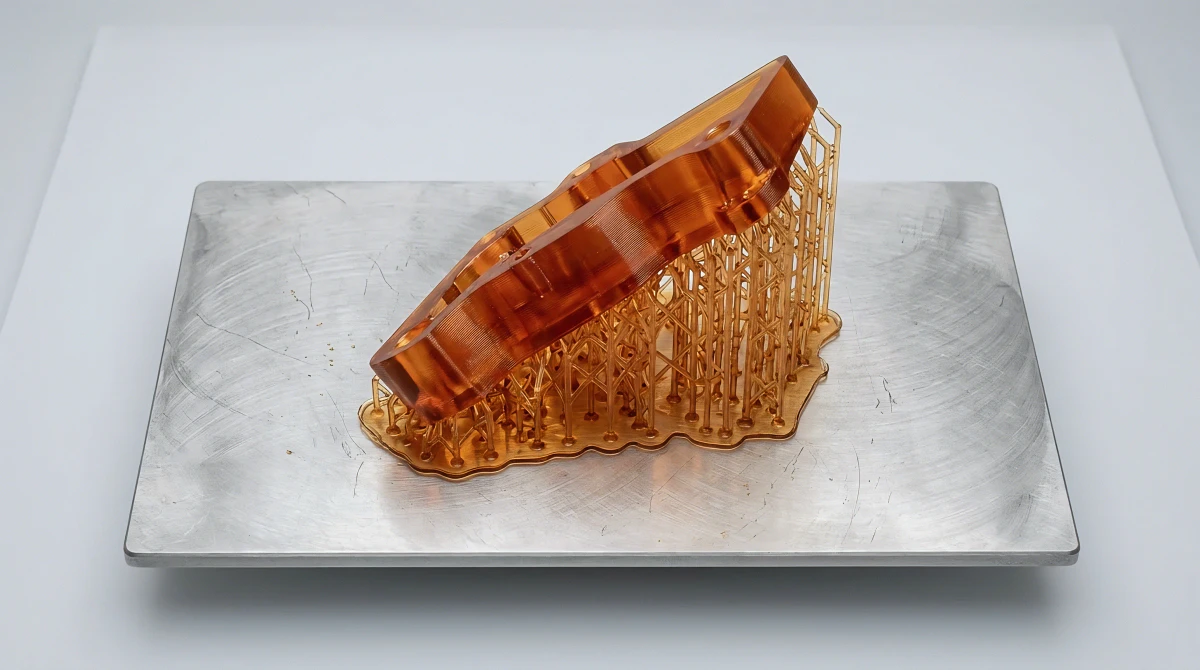
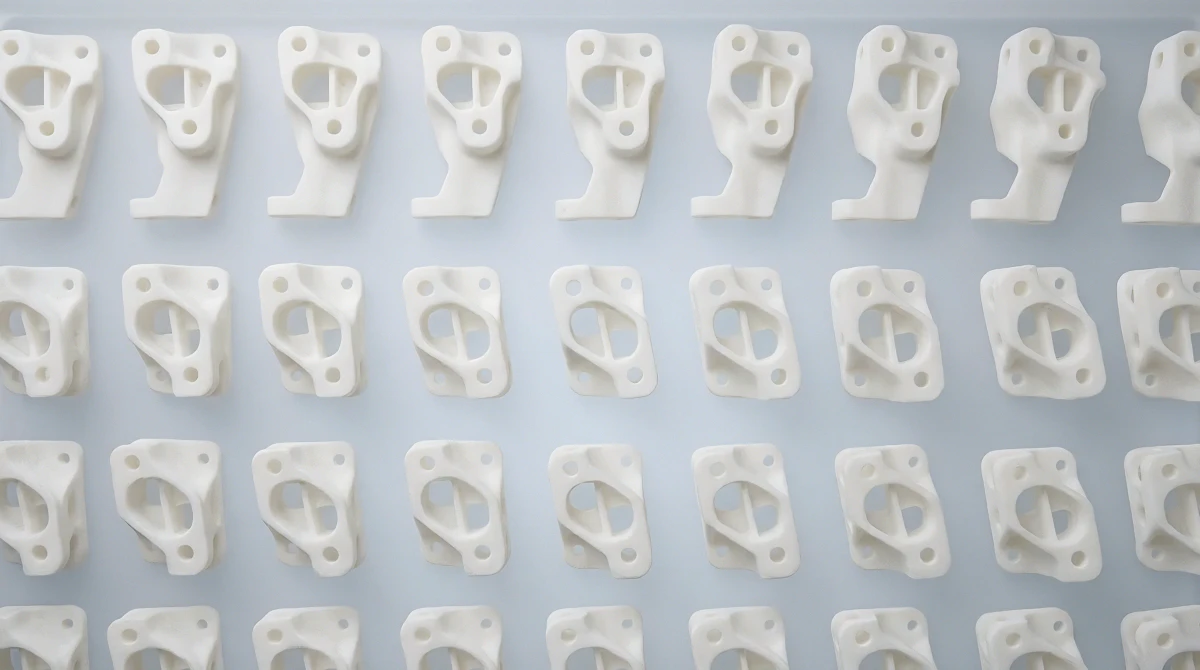
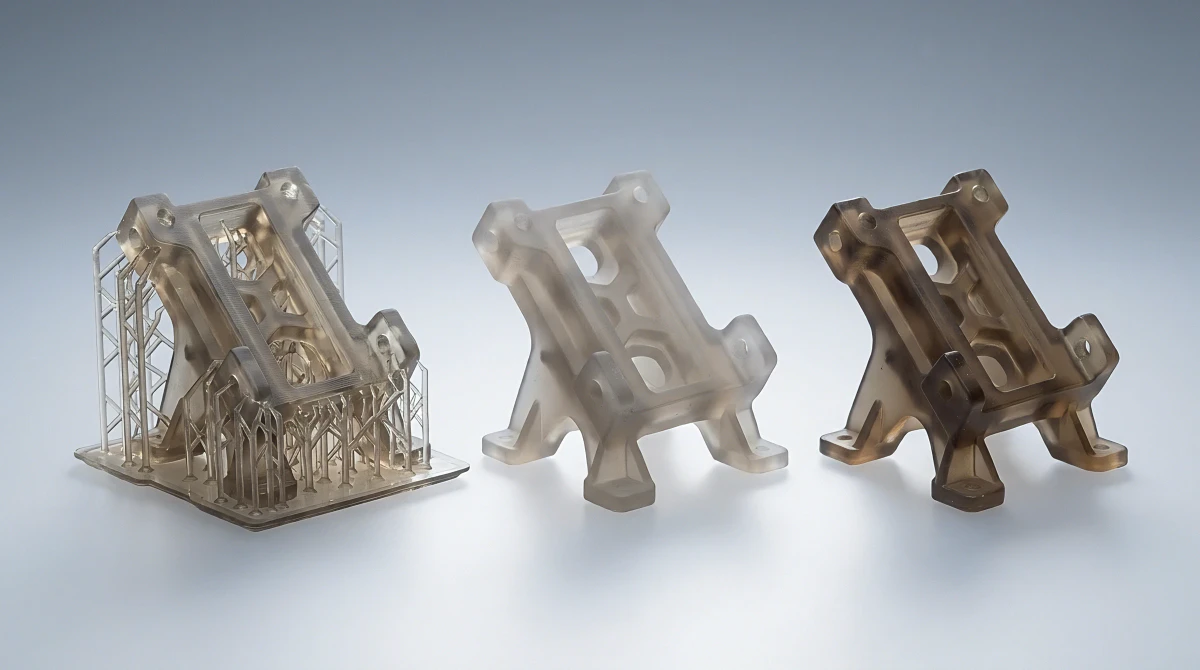
Stereolithography (SLA) builds a part from liquid resin that a light source cures into thin solid layers. ISO/ASTM 52900 places it in the vat photopolymerization category, beside digital light processing (DLP). The part leaves the printer green and is washed, dried and post-cured before its supports come off. Its tolerance is published as a percentage of feature size with a small floor.Tolerance Bands
Formlabs gives ±0.15 % for features of 1 to 30 mm (0.04 to 1.18 in). It gives ±0.2 % for 31 to 80 mm (1.22 to 3.15 in). It gives ±0.3 % for 81 to 150 mm (3.19 to 5.91 in), with a floor of ±0.02 mm (±0.0008 in). The 3D Systems SLA 750 gives ±0.051 mm (±0.002 in) below 34 mm (1.34 in) and 0.15 % cumulatively above. At 100 mm (3.94 in) the two statements differ by a factor of 2, ±0.3 against ±0.15 mm (±0.012 against ±0.006 in). At 50 mm (1.97 in), the Formlabs bands give ±0.100 mm (±0.0039 in) and the SLA 750 ±0.075 mm (±0.0030 in). At 150 mm (5.91 in) they give ±0.450 and ±0.225 mm (±0.0177 and ±0.0089 in). The Formlabs bands stop at 150 mm. The SLA 750 statement keeps growing, to ±1.125 mm (±0.044 in) at its 750 mm (29.5 in) build limit.Read More
Band Boundaries
The Formlabs bands form a staircase. A 30 mm feature carries ±0.045 mm (±0.0018 in), while a 31 mm feature carries ±0.062 mm (±0.0024 in), a jump of 38 %. At the 80 and 81 mm boundary the jump is about 52 %. A designer who knows the boundaries keeps a critical feature under one where the part allows. The 3D Systems statement has no such step. Its 0.15 % of 34 mm (1.34 in) is 0.051 mm (0.002 in), so the flat figure and the percentage meet.Finishing Sequence
Formlabs washes resin parts for 5 to 20 minutes depending on the resin. After an isopropyl alcohol wash, parts dry at least 30 minutes before the cure. Supports come off after post-cure, because parts can warp under light and heat without them. Post-cure shrinks the part, so the tolerance applies after it. The marks at support contacts are sanded where a face needs it. The SLA 750 lists a layer resolution of 50 to 150 µm (0.002 to 0.006 in). It lists an XY feature size down to 0.0127 mm (0.0005 in). Those lines describe detail, and the tolerance line describes size. A buyer who reads 50 µm layers as a tolerance reads the wrong line.Fits
Consider an assumed 10 mm (0.39 in) pin running in a 10.2 mm (0.40 in) hole. On the Formlabs floor the clearance runs from 0.16 to 0.24 mm (0.006 to 0.009 in). On the SLA 750 figure it runs from 0.098 to 0.302 mm (0.004 to 0.012 in), more than twice the spread. With both parts at 10.0 mm, the same figure gives anything from 0.102 mm (0.004 in) of interference to 0.102 mm of clearance. Formlabs adds that compliant materials have wider tolerance zones, and that wear opens clearances over time.Materials
Tough SLA grades are sold as stand-ins for thermoplastics. Formlabs benchmarks Tough 2000 Resin V2 against ABS, and 3D Systems describes Accura 25 as simulating machined polypropylene. Their loaded heat deflection sits near 50 to 57 °C (122 to 135 °F), below the ABS they imitate. Somos EvoLVe 128 is the stiffest tough grade compared, at 2,964 MPa (430 ksi). Tough 2000 Resin V2 stretches 79 %, against 8 % for extruded ABS sheet.Throughput
In a 2026 review, vat photopolymerization made 7.62 parts per hour per batch on a 30 mm (1.18 in) cube. It made 14.00 parts per hour in a continuous 120-hour scenario. The review’s numbers depend on its assumptions about the cube, the machines and the post-processing. Hands-on time scales with parts, since a batch of 3,000 resin parts has 3,000 sets of supports to cut.