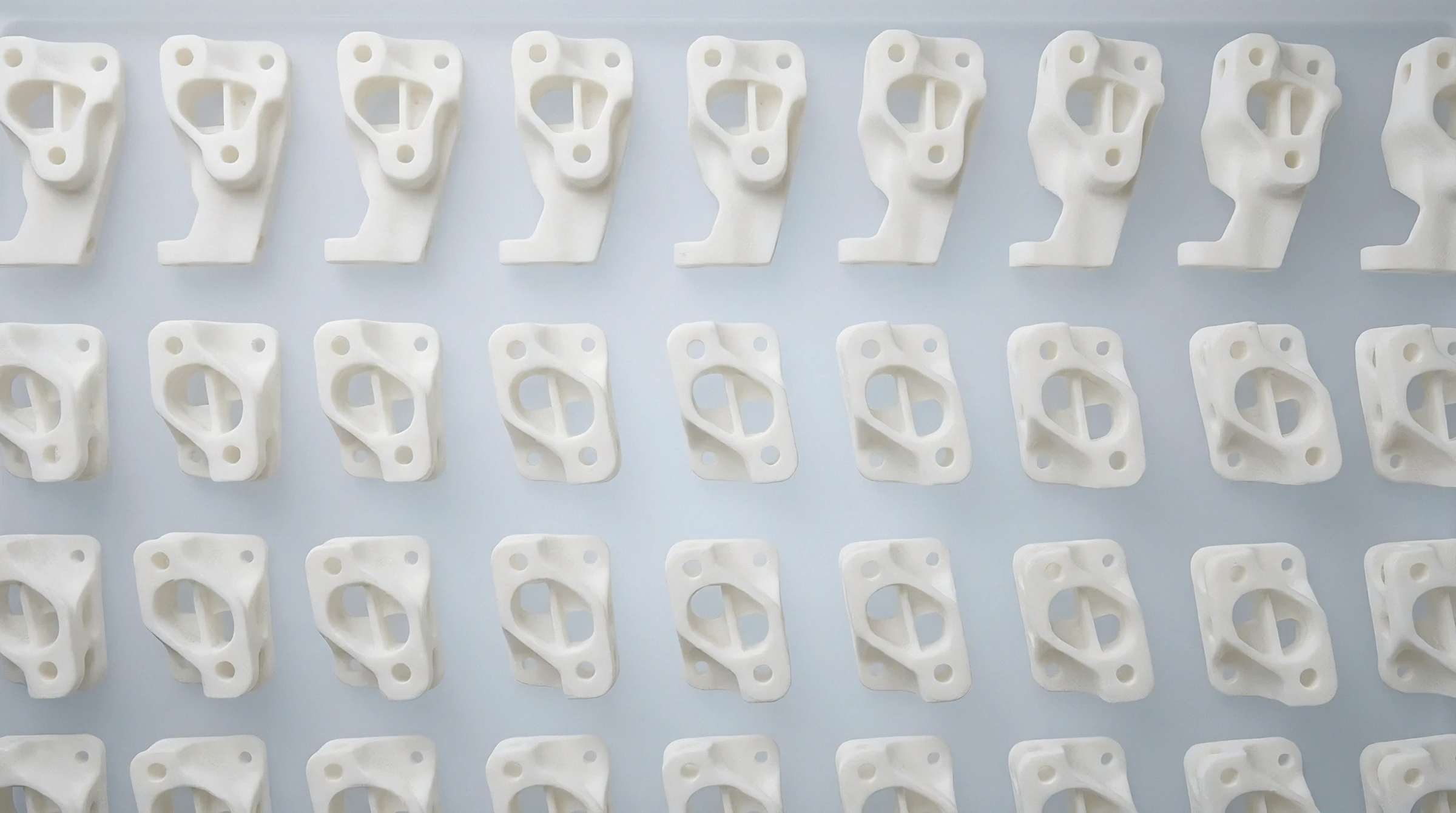
A Fuse X1 build of 3,231 nylon parts takes 43 hours on the printer, 32 hours more to cool, and then 35 to 40 minutes from the sifting station to finished parts. Formlabs prints all three numbers on one comparison page. Add the first two and the build is 75 hours old before the first part is blasted, and all but about 20 to 25 minutes of the whole span is time with no person at the parts.
A batch’s lead time is the sum of stages that run on different clocks: the printer’s, the cooling cake’s, the furnace’s and the bench’s. Most of the figures a maker publishes cover one of them. The sections below set the stages side by side for powder bed fusion, resin and metal, with each figure’s source, and mark clearly where the sources stop and the arithmetic starts.
Lead Time for a 3D Printed Batch Stage by Stage
The calendar of a batch has the same skeleton in every process. Files are prepared and nested, the machine builds, the work cools or cures, parts are separated from what held them, and finishing and inspection follow. What differs is which stage is long.
| Stage | Polymer powder bed fusion | Resin (SLA) | Metal powder bed fusion |
|---|---|---|---|
| Build | 43 h for 3,231 parts on a Fuse X1 | set by layer count and exposure | volume rate 3.7 mm3/s for 316L at 40 µm |
| Cool or hold | 32 h cooling after that build | at least 30 min drying after an IPA wash | stress relief at least 2 h at 900 °C for 316L |
| Separate | sift about 15 to 20 min | supports cut after cure | cut from the plate by bandsaw or wire erosion |
| Clean and finish | blast about 20 min | wash 5 to 20 min by resin; cure 12 min at 70 °C for Tough 2000 V2 | blast, optional machining |
| Inspect | gauge and measure | measure after cure | scan, CMM, CT |
| Sources | Formlabs comparison page | Formlabs Form Wash and Tough 2000 pages | EOS data sheets, MakerVerse guide |
The long stages are the ones with no person at them: the build and the cooldown. The stages with people in them are measured in minutes.
The Print Stage
The print is the stage with the most published detail. For a powder bed polymer build, the Fuse chamber’s layer thickness is 110 µm (0.004 in), so a build 300 mm (11.8 in) tall is about 2,730 layers and one 565 mm (22.2 in) tall is about 5,140. Formlabs puts the Fuse X1’s maximum throughput at 0.33 kg/h and HP’s 5200 series at about 0.11 kg/h on its comparison page, which are the maker’s figures for maximum rates and not guarantees for a given job.
At those rates the mass of parts per day is a plain product. The Fuse X1 at 0.33 kg/h produces about 7.9 kg of parts in 24 hours, and the HP rate gives about 2.6 kg. The arithmetic assumes the machine prints without a pause, which the cooling and unloading will interrupt unless a second chamber is ready. On Formlabs’s own page, a 43 hour Fuse X1 build of 3,231 parts averages about 4.4 g per part, which is 14.2 kg in total.
For a metal build, EOS gives a volume rate per parameter set instead of a mass rate: 3.7 mm3/s at 40 µm, 8.4 mm3/s at 80 µm for 316L on the EOS M 290, and 2.0 mm3/s at 20 µm. The maker notes that the rate depends on part dimensions and skin thickness. For a 100 cm3 part, 3.7 mm3/s gives about 7.5 hours of exposure and 8.4 mm3/s about 3.3 hours, before recoating time. These are arithmetic, not measured build times.
For resin there is no published time per layer in the sources opened for this article. The Somos EvoLVe 128 datasheet gives a critical exposure of 9.3 mJ/cm2 and an exposure of 95.1 mJ/cm2 for a layer 0.254 mm (0.010 in) thick, from which a machine with a known laser power could derive an exposure time, but the datasheet does not do so and neither does this article.
The print is the part of the clock that a quotation usually names. The cooldown, the cure and the furnace are the parts it usually leaves out.
The Wait After the Print
A powder bed polymer build ends hot. Formlabs asks for the chamber to be cooled to about 50 °C (122 °F) before unpacking, and at a minimum to between 50 and 70 °C (122 and 158 °F), and its cooldown test found that parts pulled at 100 °C (212 °F) warped about twice as much as parts pulled at room temperature. The Fuse X1 example cooled for 32 hours, which is about three quarters of the print time of 43 hours. HP’s 5200 series, in Formlabs’s account, spends about 120 hours in total cooling across four builds of 808 parts and 46 hours of printing.
The HP figure is a competitor’s reading, and HP describes its own arrangement differently: a Natural Cooling Unit designed to remove and cool each build, so the printer can continue production. The figures cannot be compared without knowing whether the cooling takes place in a separate unit or in the machine. They do show the shape of the problem: the wait is as large as the print, or larger.
A resin part’s wait is short. Formlabs asks for at least 30 minutes of drying after an IPA wash, with ventilation, and about 10 minutes of air drying for Tough 2000 Resin V2 before handling, and then a cure of 12 minutes at 70 °C for that resin on a Form Cure V2. A metal part’s wait is the heat treatment. EOS asks for at least 2 hours at 900 °C for stress relief when the part is thoroughly heated, which excludes the time for the furnace to reach and leave that temperature, and the sources do not state that time.
| Process and material | Waiting step | Figure | Source |
|---|---|---|---|
| Nylon 12 powder bed, Fuse X1 | cooling after a 43 h build | 32 h | Formlabs comparison page |
| Nylon 12 powder bed, Fuse 1+ 30W | chamber to unpacking temperature | to 50 °C ideal, 50 to 70 °C minimum | Formlabs cooldown blog |
| Resin, IPA wash | drying before cure | at least 30 min | Formlabs SLA basic finishing |
| Resin, Tough 2000 Resin V2 | cure | 12 min at 70 °C | Formlabs Tough 2000 page |
| Stainless steel 316L, EOS M 290 | stress relief | at least 2 h at 900 °C | EOS 316L data sheet |
The Hands-On Stages
The people-time per batch is small in the best case. Formlabs states 20 to 25 minutes of active labor inside a 35 to 40 minute span from chamber to finished part on a Fuse X1, with about 15 to 20 minutes for the Sift and about 20 minutes for the Blast. For the HP series, the same page says unpacking is manual or semi-manual, integrated blasting is not offered, and total active labor can take several hours. HP’s own pages list an automatic unpacking station and automation for build unit exchange and powder handling, so the labor on an HP line depends on which of those a given operator has installed.
Resin finishing is human work at each part: supports are cut with flush cutters, a scalpel or a hobby knife after curing, and marks are sanded if the face needs it. The sources give no minutes per part. For metal, the MakerVerse guide describes supports removed by hand with hammers, chisels, tongs or grinders and calls the work time-consuming and labor-intensive, with no figure given.
The consequence is that the hands-on time scales with parts, and the waiting time scales with builds. A batch of 3,000 small nylon parts that fits one build has one cooldown and one blast routine. A batch of 3,000 resin parts has 3,000 sets of supports to cut.
Throughput Figures From the Mass Customization Review
A 2026 review in the International Journal of Precision Engineering and Manufacturing-Green Technology, by Ji, Kim and Lee, compared processes on a 30 mm (1.18 in) solid cube of 27 cm3. According to the report on it, the throughput in parts per hour for a single batch and for a continuous 120 hour scenario came out as below. The machines named include the Stratasys F3300, the 3D Systems Figure 4 Modular, the Desktop Metal P-50 and the Stratasys H350, though the report does not map each to a process row.
| Process family | Per batch | Continuous 120 h |
|---|---|---|
| Material extrusion | 7.43 | 7.23 |
| Vat photopolymerization | 7.62 | 14.00 |
| Metal binder jetting | 5.30 | 32.25 |
| Powder bed fusion | 4.42 | 9.47 |
The shape of the table is the interesting part. Powder bed fusion reaches 9.47 parts per hour in continuous running, more than double its per-batch figure, which is what waiting time does to a single batch. For metal systems the report gives about 4 hours of printing and up to 36 hours of sintering, cooling and depowdering, and polymer post-processing as typically several hours. The report is a review, and its numbers depend on its assumptions about the cube, the machines and the post-processing available.
Several Builds in Sequence or Machines in Parallel
A batch that needs more than one build has a lead time that depends on whether the wait overlaps the next print. The Fuse chamber is a modular unit that moves between printer and Sift, and the cooldown test cooled its chambers outside the printer. If the printer takes a second chamber while the first cools, the wait of the first build runs under the print of the second.
An illustration with the Fuse X1 example, assuming two identical builds of 43 hours print and 32 hours cooling. With one chamber that waits in the printer, the two builds take 43 + 32 + 43 + 32 = 150 hours before the second is ready to unpack. With a second chamber, the second print starts at hour 43 and finishes at 86, and cools until 118, so the last parts are ready at about 118 hours instead of 150. That arithmetic uses Formlabs’s example figures as an assumption and leaves out loading and unloading time. HP’s build unit exchange for two consecutive builds is the same idea on another platform.
The practical question for a buyer is not which machine is faster in the abstract but how many chambers or machines are working on the batch, because that sets how many cooldowns run in parallel.
A Worked Batch of 500 Parts
Take an assumed order: 500 identical parts of 20 cm3 each, in nylon 12, with no long thin features. The number of builds follows from chamber volume and packing density, with the ceilings computed from the makers’ chamber sizes.
The ceilings, from the chamber sizes and the packing densities in the published figures, come out as follows.
- Fuse 1+ at 15 percent packing density: the 8.2 L chamber holds about 61 parts of that size, so the order needs nine builds.
- Fuse X1 at 15 percent: the 61.5 L chamber holds about 461, so the order needs two builds.
- HP 5200 series at the 10 percent density Formlabs gives as the recommended maximum: the 41 L chamber holds about 205 parts, so the order needs three builds.
These are ceilings for chambers filled with the same part, and real builds carry other jobs and test pieces, so the counts are the least number of builds, not the expected number.
Each build brings its own cooldown. Nine builds on one small printer mean nine cooldowns in sequence unless chambers are swapped, while two builds on a large machine mean two. The cooldown time itself depends on the size of the cake, which is why a published example from one chamber should not be scaled to another. What the arithmetic fixes is how many times the waiting stage appears in the schedule, and that number is what a buyer can compare between two supplier plans before asking for hours.
What to Ask When a Supplier States a Lead Time
A single lead time conceals the stages. These are the questions that expose them.
- How many builds the quantity needs, and whether they run in sequence or in parallel.
- Whether cooling happens outside the printer, and to what temperature the parts are unpacked.
- Whether resin parts are cured to the datasheet condition before they ship, and the cure time and temperature.
- Whether metal parts are stress relieved before they are cut from the plate, and the furnace time.
- Which finishing steps run before the date, and which after.
ISO/ASTM 52901:2017 lists the places where these answers belong in an order: part ordering information, process and process control information, post-processing and inspection, and acceptance, with a first production part among the acceptance points. A lead time quoted against a written order is one that can be checked stage by stage.
A buyer who sees the stages can place a repeat order with the same plan, which is the pattern behind low-volume 3D printing that is carried toward bridge production.
Sources and Further Reading
- Formlabs, Formlabs Fuse X1 compared with the HP Jet Fusion 5200 Series
- Formlabs, Fuse Series Cooldown Recommendations
- Formlabs, Fuse Series SLS 3D Printers Technical Specifications
- Formlabs, SLA basic finishing
- Formlabs, Form Wash and Form Wash L time settings
- Formlabs, Tough 2000 Resin V2
- HP, HP Jet Fusion 5200 industrial 3D printer
- Stratasys, Somos EvoLVe 128 stereolithography material
- EOS, EOS StainlessSteel 316L material data sheet
- EOS, Process data sheet, EOS StainlessSteel 316L-4404 for EOS M 290, 40 µm
- MakerVerse, The guide to laser powder bed fusion (LPBF) post-processing
- 3D Printing Industry, Additive manufacturing benchmarked against injection molding in mass customization study, reporting Y. Ji, M. Kim, B. J. Lee, International Journal of Precision Engineering and Manufacturing-Green Technology, 2026
- ISO and ASTM, ISO/ASTM 52901:2017, requirements for purchased AM parts