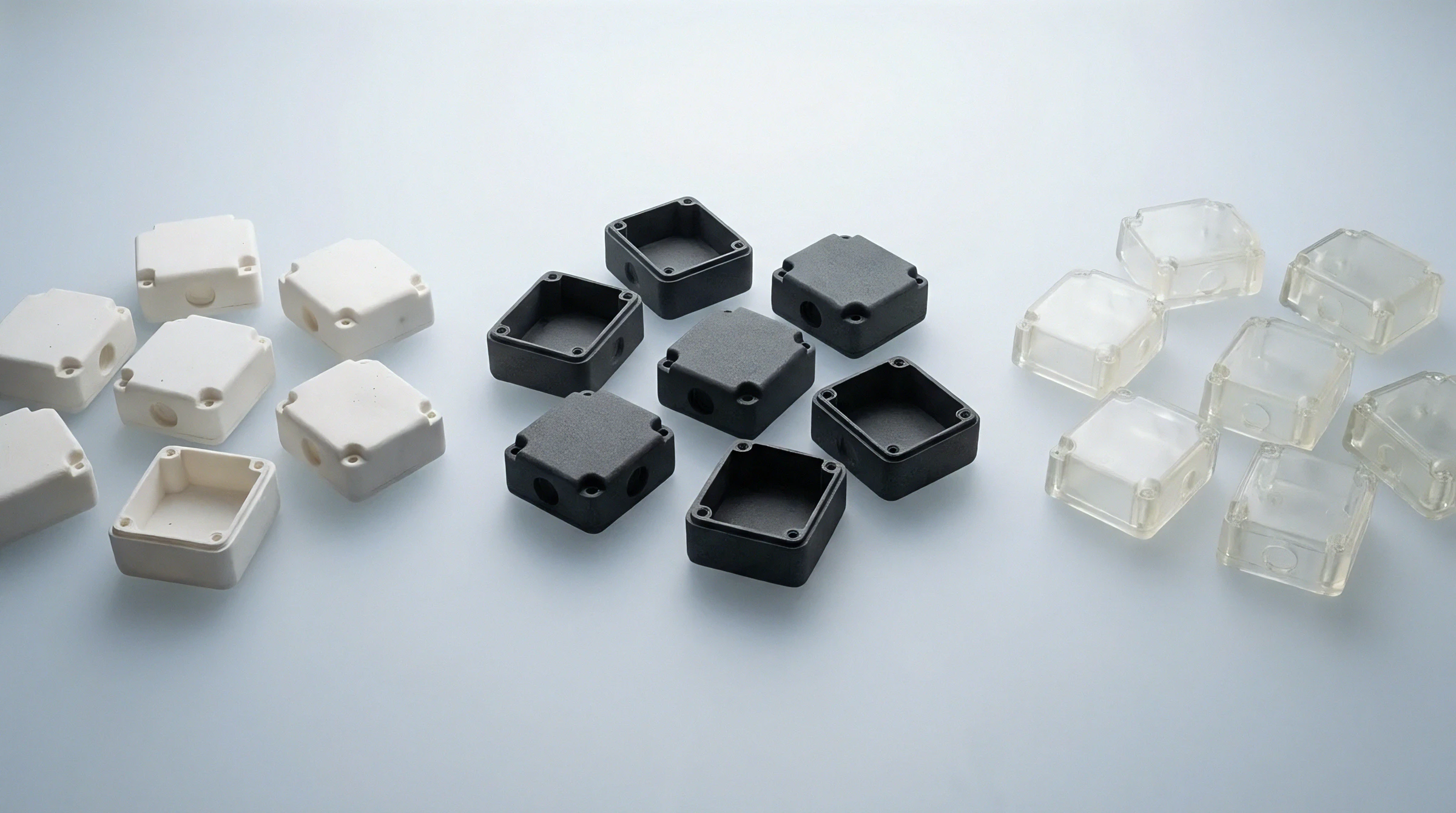
EOS’s PA 2200 nylon, laser sintered at its Balance setting, stretches 18 % before it breaks when the bar is built flat and 4 % when it is built upright. An SLA bar in Accura ClearVue on a ProJet 6000 HD gave the same strength in every orientation tested, and its strength more than doubled, from 24 to 54 MPa (3,480 to 7,830 psi), between one week and six months of age. A run of 200 parts chosen between these processes is a choice between those two kinds of behavior long before it is a choice between machines.
Selective laser sintering (SLS), HP Multi Jet Fusion (MJF) and stereolithography (SLA) all make plastic parts without a mold, and all three can carry a run of 50 to 500 parts. They differ in material family, in how parts are packed into a build, in what happens after printing, and in what a buyer has to write into the order to get the same part at the end of the run as at the start. The sections below compare them on those points from the makers’ published specifications and from studies, and finish with how the quantity changes the answer. Costs are named only as drivers.
SLS, MJF and SLA Compared for a Production Run
The first split is the material. SLS and MJF fuse thermoplastic powder, mostly nylon, and the part is the polymer itself. SLA cures a liquid photopolymer resin, which makes a thermoset whose formulation imitates a thermoplastic. Every other difference follows from that.
| Point | SLS | MJF | SLA |
|---|---|---|---|
| Example system | 3D Systems SLS 380 | HP Jet Fusion 5200 | 3D Systems SLA 750 |
| Build envelope | 381 × 330 × 460 mm (15 × 13 × 18 in) | Not given on the page opened | 750 × 750 × 550 mm (29.5 × 29.5 × 21.65 in) |
| Layer | 120 µm (0.0047 in) for EOS PA 2200 Balance | 80 µm (0.0031 in), about 10.5 s a layer on an HP 4200 in one study | 50 to 150 µm (0.002 to 0.006 in) |
| Supports | None, per 3D Systems; the powder bed carries the part | Not stated on the page opened | Needed for overhangs and islands |
| Packing | Automated 3D nesting through the build height | Parts placed in the powder, 10 to 15 mm apart in one study | Parts on the platform, one level |
| Materials named | Nylon 11 and nylon 12, filled and flame-retardant grades | HP 3D HR PA 11, PA 12, PA 12 S, PA 12 GB, PP; Ultrasint TPU01 | PP-like Accura 25; ABS and PP replacements; flame-retardant UL 94 V0 resin; Somos EvoLVe 128 |
| Stated speed or accuracy | Up to 2.7 l/h (165 in³/h) | Not given on the page opened | ±0.051 mm (±0.002 in) under 34 mm, 0.15 % cumulative above |
Sources: 3D Systems SLS 380 and SLA 750 product pages; HP Jet Fusion 5200 product page; EOS PA 2200 Material Data Sheet; University College Dublin study on MJF PA12; University of Zurich SLS guideline, which states the powder bed provides the support; Carbon and Stratasys design guides on supports for resin parts.
The accuracy row is the SLA maker’s statement for its own system; neither powder page opened states a tolerance. A study of 50 nylon 12 parts on a 3D Systems ProX SLS 6100 found inner diameters undersized by about 0.1 mm (0.004 in) and outer diameters close to nominal, which is the sort of figure a buyer asks a powder bed supplier to show from its own machine.
Laser sintering prints a thermoplastic part in a cake of powder without supports. SLA prints a resin part on supports with a smoother skin. The run inherits both.
Material Properties the Run Has to Live With
| Material and process | Tensile strength | Elongation at break | Modulus | Heat deflection |
|---|---|---|---|---|
| EOS PA 2200 nylon 12, SLS, X / Z | 48 / 42 MPa (6,960 / 6,090 psi) | 18 / 4 % | 1,650 MPa (239 ksi) | 157 °C X, 145 °C Z at 0.45 MPa (315 / 293 °F) |
| HP 3D HR PA 12 GB, MJF, average | 31 MPa (4,500 psi) | 6.1 % | 2,276 MPa (330 ksi) | Not reported |
| Accura ClearVue SLA, ProJet 6000 HD | 51.9 ± 1.3 MPa (7,530 psi) | 4.8 ± 0.4 % | 2,481 ± 50 MPa (360 ksi) | Not reported |
Sources: EOS, Material Data Sheet PA 2200 Balance, ISO 527-1/-2 and ISO 75-1/-2; University College Dublin, Comparison between the properties of polyamide 12 and glass bead filled polyamide 12 using the multi jet fusion printing process; Arizona State University study in Materials. The SLA values were tested to ASTM D638 and were close to the supplier’s 52 MPa, 2,550 MPa and 6 %.
Three behaviors separate the processes for a run.
- Direction. The EOS sheet shows nylon 12 losing most of its elongation in Z, 18 % against 4 %. The SLA study found no statistically significant effect of build or angular orientation on strength, modulus or elongation, and classed its parts as isotropic. The MJF study found its glass-bead composite isotropic in strength and its parts strongest and least porous in one orientation, with porosity under 1 % for both materials by X-ray CT.
- Age. The SLA bars gained strength for months after printing. A run printed over several weeks and tested at delivery mixes parts of different ages.
- Heat. PA 2200 carries a deflection temperature of 157 °C at 0.45 MPa in X and a melting point of 176 °C (349 °F); the SLA pages opened give no comparable figure for their general-purpose resins.
Matching the Material to the Part
The makers’ application lists draw the same lines. 3D Systems lists housings, enclosures, snap fits, living hinges, ducts and machinery components for SLS 380 nylons. EOS lists grippers, jigs, fixtures, brackets, covers and functional parts with hinges or threads for PA 2200. For SLA, 3D Systems positions Accura 25 for snap-fit assemblies, styling parts and master patterns for urethane casting, and Stratasys describes Somos EvoLVe 128 as producing parts close in look and feel to finished thermoplastics, for functional testing. A part that has to be a thermoplastic in service points to a powder process; a part whose first need is surface and detail points to SLA.
Within one powder process the grade changes the part as much as the process does. The University College Dublin study printed HP 3D High Reusability PA 12 and its glass-bead grade on an HP Jet Fusion 4200 in the balanced mode, one of four print modes the printer offers alongside mechanical, fast and cosmetic. Adding glass beads raised tensile and flexural modulus by 85 % and 36 % and lowered tensile and flexural strength by 39 % and 15 %, while crystallinity fell from 31 to 24 % and the melting point stayed near 185 °C (365 °F). A buyer who needs a stiffer housing and one who needs a tougher clip choose different grades on the same machine, and the run is qualified on the grade.
Packing a Build and Counting Builds per Quantity
A run of 50 to 500 parts is counted in builds, and the number of parts in a build is the process’s equivalent of cavities in a tool. Powder bed processes stack parts through the whole height of the chamber, because the unfused powder holds them. SLA places parts on one platform, and every part needs its own supports.
The arithmetic below uses stated assumptions to show how far apart the two can be. It is an illustration, not a quote.
| Item | SLS 380, 381 × 330 × 460 mm | SLA 750, 750 × 750 × 550 mm |
|---|---|---|
| Parts across X at 70 mm pitch | 5 | 10 |
| Parts across Y at 50 mm pitch | 6 | 15 |
| Levels in Z at 40 mm pitch | 11 | 1, parts on the platform |
| Parts per build, before any packing losses | 330 | 150 |
| Builds for 50 parts | 1 | 1 |
| Builds for 500 parts | 2 | 4 |
Assumptions: a 60 × 40 × 30 mm (2.4 × 1.6 × 1.2 in) bounding box, laid flat, 10 mm (0.39 in) between parts, the spacing a University College Dublin study used on an HP build; envelopes from 3D Systems’ pages. Real nesting rotates parts and follows the maker’s thermal limits; SLA supports raise each part off the platform.
The difference grows with quantity. At 50 parts both processes need one build. Toward 500, the powder bed’s third dimension halves the build count in this example, and each SLA build carries 150 parts’ worth of supports to remove. Carbon’s orientation guide for its resin printers makes the trade explicit: the shortest print time often conflicts with the most parts per build, so both are weighed together.
Time Around the Build
Build time is only part of the cycle. The ProX SLS 6100 study’s 50-part build ran 11 h 13 min, of which 1 h 58 min was cool-down, and the powder cake was then left 24 hours to reach room temperature. In the MJF study, builds cooled overnight before unpacking. HP sells a natural cooling unit for the 5200 that removes each build to cool so the printer can start the next, and an automatic unpacking station, and an accessory that exchanges build units automatically for two consecutive builds. On the finishing side, DyeMansion states that its shot-surfacing machine takes three quarters of an EOS P396 build or a full HP Jet Fusion 4200 or 5200 build in one 10-minute batch.
In a powder bed the third dimension of the chamber is free capacity. In SLA every part sits on the platform, and every part has supports to remove.
Design Limits That Differ Between the Processes
A part drawn for one process does not always print in the others, and a run is the wrong time to find out. The makers’ and labs’ design rules show where the limits sit.
- Walls. HP gives 0.3 mm (0.012 in) for short walls in XY and 0.5 mm (0.020 in) in Z for MJF. The University of Zurich SLS guideline recommends 1.0 to 6.0 mm (0.039 to 0.24 in) walls and 1.0 mm for reproducible supported walls. Stratasys gives 0.25 mm (0.010 in) minimum and 0.5 mm recommended for unsupported walls on its resin printer.
- Holes and drains. Zurich gives a 1.5 mm (0.059 in) minimum hole and 4.0 mm (0.157 in) powder escape holes, at least two and opposite. Stratasys gives a 0.2 mm (0.008 in) minimum through hole and a 3 mm (0.12 in) drain hole for enclosed resin volumes.
- Assemblies. HP asks for 0.7 mm (0.028 in) between parts printed as assemblies and 0.4 mm (0.016 in) between parts fitted after printing. Zurich gives 0.5 mm and 0.2 mm (0.020 and 0.008 in) for SLS.
- Warpage. HP warns that parts with an aspect ratio over 10:1, abrupt section changes or long thin curves are susceptible to warping from uneven cooling in MJF.
- Overhangs. Powder bed parts need no supports; resin parts need them below the maker’s self-supporting angle, about 30° for Stratasys and commonly 40° for Carbon’s resins.
A design that passes all three sets of rules keeps the process choice open until the quantity and material settle it.
Powder Reuse and Lot-to-Lot Drift Across a Run
Powder bed processes reuse the unfused powder, and its condition moves through a long run. The MJF study used 20 % new to 80 % recycled powder for HP 3D HR PA 12 and 30:70 for the glass-bead grade, as HP recommends. Forward AM lists 80:20 used to new for its TPU powders and 50:50 for its PA11. A University of Birmingham study refreshing nylon 12 at 30 % for seven laser sintering builds measured porosity up 5.8 % and tensile strength down 11 % by the seventh build, and a Staffordshire University study found shrinkage moved enough over six reuse cycles to change part size.
3D Systems builds powder handling into the SLS 380 to control, blend and deliver fresh and recycled powder at a set ratio, and HP offers automated powder handling for the 5200 to keep material quality consistent. For a 500-part run spread over several builds, the refresh ratio and the build count of the powder belong in the supplier’s record.
SLA has its own version of drift: the parts themselves change with time after printing, as the ProJet study’s strength gain shows. A run that will be compared part to part is best tested at a fixed age after printing.
Surface and Finishing for the Run
As printed, SLA is the smoother process by a wide margin. A review of as-printed polymer roughness lists SLA studies at roughly 1 to 3 µm Ra (40 to 120 µin) on most faces, against about 12 to 15 µm (470 to 590 µin) for laser-sintered and MJF nylon. Powder bed parts are commonly blasted clean and can then be shot surfaced, dyed or vapor smoothed; DyeMansion reports vapor smoothing taking PA 2200 from 7.67 to 1.89 µm Ra and HP 3D HR PA 12 from 9.79 to 1.60 µm in its tests. SLA parts need support removal, cleaning and post-cure, which Stratasys’s design guide asks designers to plan for, and their support marks land on whichever faces the orientation leaves facing down. At the top of this range a run is also compared with two other ways of making it: copies made as vacuum cast parts from a printed master, which suit a few dozen parts in a production-like resin, and an injection mold once the design has settled and the quantity runs into thousands.
How the Quantity Changes the Choice
The sources point to a short set of rules for a run of this size.
- Choose by material first. A part that has to be nylon, PP or TPU in service is a powder bed part; a part that needs a smooth, detailed resin surface is an SLA part.
- At the low end, around 50 parts, both fit in one build and the decision rests on material, finish and accuracy.
- Toward 500 parts, count builds. Small parts that stack favor the powder bed; large parts that fill a platform narrow the gap, and the SLA 750’s larger envelope takes parts the SLS 380 cannot.
- Write the direction of loading for powder bed parts, and the test age for SLA parts.
- Ask for the powder refresh practice on a multi-build run, and for first-part data from the supplier’s own machine on any dimension that matters.
The cost drivers follow the same lines: material used, including powder refreshed, build count, cool-down and unpacking time, support removal and finishing labor. For a buyer weighing low-volume 3D printing against a first molded run for bridge production, the number of builds a quantity needs is the figure that shows where each process stops being the simpler answer.
Sources and Further Reading
- SLS 380 3D Printer, tech specs, 3D Systems
- SLA 750 3D Printer, 3D Systems
- Accura 25 SLA 3D Print Material, 3D Systems
- HP Jet Fusion 5200 3D Printer, HP
- Material Data Sheet PA 2200 Balance, EOS
- Somos EvoLVe 128 Stereolithography Material, Stratasys
- How to design a 3D print model, HP Multi Jet Fusion design tips, HP
- Comparison between the properties of polyamide 12 and glass bead filled polyamide 12 using the multi jet fusion printing process, University College Dublin
- Mechanical Anisotropy and Surface Roughness in Additively Manufactured Parts Fabricated by Stereolithography (SLA) Using Statistical Analysis, Materials, 2020, Arizona State University via PubMed Central
- Influence of part orientation and spatial placement on the dimensional and surface quality of SLS-printed PA12 components, Springer Nature
- Re-use of polyamide-12 in powder bed fusion and its effect on process-relevant powder characteristics and final part properties, Additive Manufacturing 80, University of Birmingham
- Aging dynamics in polymer powder bed fusion systems, the case of selective laser sintering, 2025, Staffordshire University
- Forward AM TPU Portfolio, Powders and Filaments, 2024, BASF Forward AM
- State-of-the-Art Surfacing whitepaper, 09/2022, DyeMansion
- Surface roughness of as-printed polymers, a comprehensive review, 2023, Springer Nature
- Orientation and Supports, Carbon
- Stratasys Origin One Design Guide, Stratasys
- Design Guideline SLS, University of Zurich