Unfused Powder

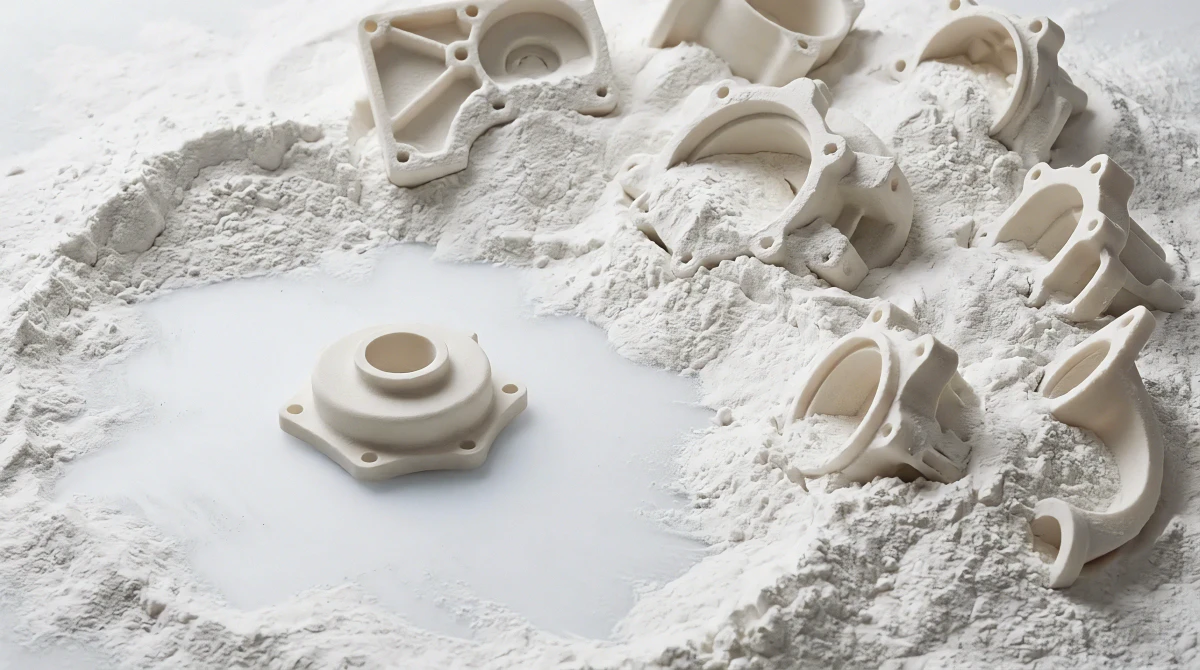
Unfused powder is the powder in a powder bed build that the laser or fusing agent leaves loose, around and between the parts.

Every Unfused Powder article of the 3D Printing Resources, newest first, each written from published standards, research and makers’ data.

Meaning

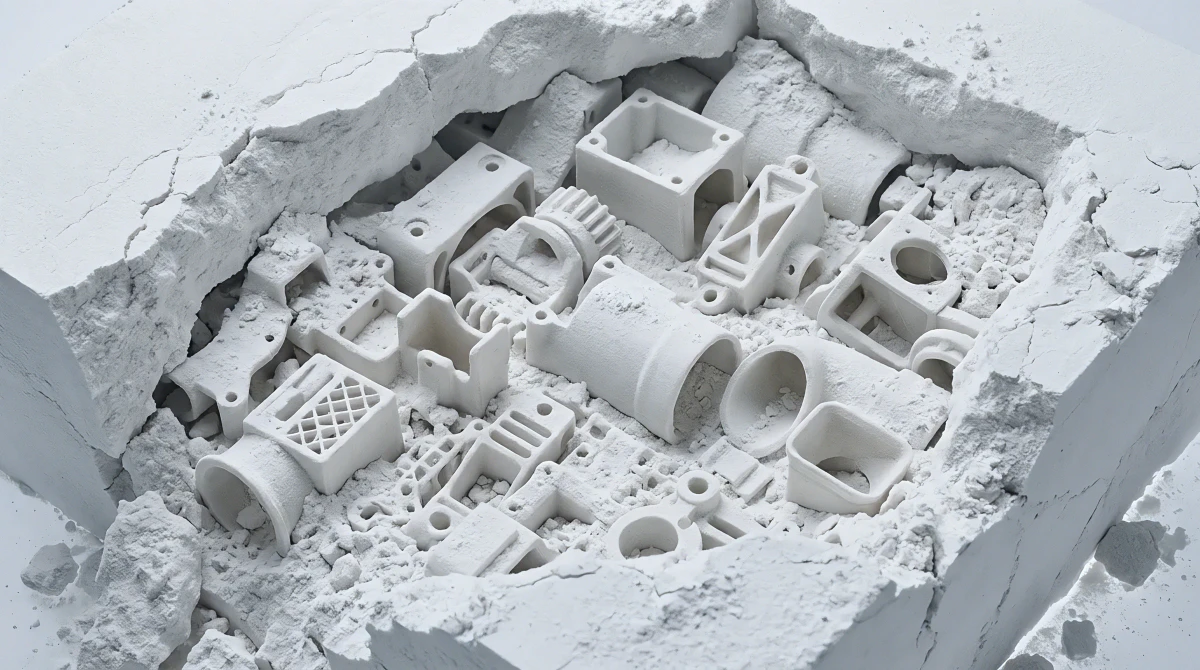
Unfused powder is the powder in a powder bed build that the laser or fusing agent leaves loose, around and between the parts. In polymer powder bed fusion it supports the parts during the build, so no support structures are needed. At the end of a build it forms the cake that holds the heat. After unpacking it is sieved and, within the maker’s refresh rule, used again.

Support and Cake

Selective laser sintering (SLS) and Multi Jet Fusion (MJF) need no support structures, which is why the Formlabs specifications list supports as none. The cake around the parts is mostly unfused powder. It keeps its heat long after the last layer, so the parts inside go on cooling and shrinking until unpacking.
Read More

Reuse

Formlabs uses 30 % fresh powder for nylon 12 on the Fuse X1. Up to 70 % of a build’s powder can therefore come from earlier builds. HP states 80 % surplus reusability for High Reusability PA 12 at a 20 % refresh rate. HP applies that claim at packing densities above 20 %. The reused share carries the thermal history of earlier builds.

Mass Against Volume

Loose powder is far lighter than fused part. HP gives a bulk density of 0.425 g/cm³ (0.0154 lb/in³) for the powder and 1.01 g/cm³ (0.036 lb/in³) for the part. A packing density stated by mass therefore reads higher than one stated by volume for the same build.

Trapped Powder

Powder left in a closed cavity, thread or thin channel is the common fault of depowdering. It shows as a part that rattles, a hole narrower than drawn or a thread that will not take a gauge. A buyer can weigh a few parts against the average and pass a gauge pin through each critical bore. Computed tomography finds trapped powder inside a part.

3D Printing Defects in a Production Batch Traced to Their Cause

A defect in a printed batch is traced by its pattern, every part, one zone, one build or a slow trend across builds, and each pattern points to its own cause and evidence.

Reading a Defect by Its Pattern Across the BatchThe 2022 review sorts the sources of metal powder bed defects into three groups: defects transferred from the feedstock powder, defects formed in the interaction of the beam with powder and metal during melting, and defects created in post-processing such as heat treatment. It adds a fourth set of contributors around them: the equipment, powder handling and dispensing, and build preparation, meaning orientation and supports.

How Many Parts Fit in One SLS or MJF Build

Chamber volume times packing density divided by part volume sets the count, and every term has a published limit.

How Many Parts Fit in a Powder Bed Fusion BuildPowder bed fusion, one of the seven process categories in ISO/ASTM 52900, builds parts inside a bed of powder that supports them, so a chamber can be filled in three dimensions and the parts need no support structures. The count that results is set by three quantities: the usable volume, the share of that volume that holds parts, and the volume of the part itself.

SLS Nylon 12 Dimensional Tolerance in XY and Z

Laser sintered nylon holds far tighter size in the layer plane than across the layers, so a drawing writes the axes apart and states build position, scaling and measured data.

SLS Nylon 12 Tolerance in XY and in ZTable 1 lists the statements, then applies them to sizes a designer uses. The guide gives the XY rule for SLS and MJF as ±0.5 % or 0.3 mm, whichever is larger.

ISO/ASTM 52900 Additive Manufacturing Terms and the Seven Process Categories

The vocabulary standard fixes the words an additive order is written in, so name the process category beside the brand and let other standards set quality.

What ISO/ASTM 52900 Covers and What It Leaves OutISO/ASTM 52900 establishes and defines the terms used in additive manufacturing (AM), the technology that applies an additive shaping principle and builds physical three-dimensional geometries by successive addition of material. Its scope sentence also states that the terms are classified into specific fields of application.

Send the 3D File of Your Printed Part

Send the 2D drawing and the 3D file, with the quantity and the stage of the project. An engineer replies within 1 working day.

The quote form, the mutual NDA and the private folder for your files are on Protolis Atelier, with 3D Printing chosen.

Request a Quote