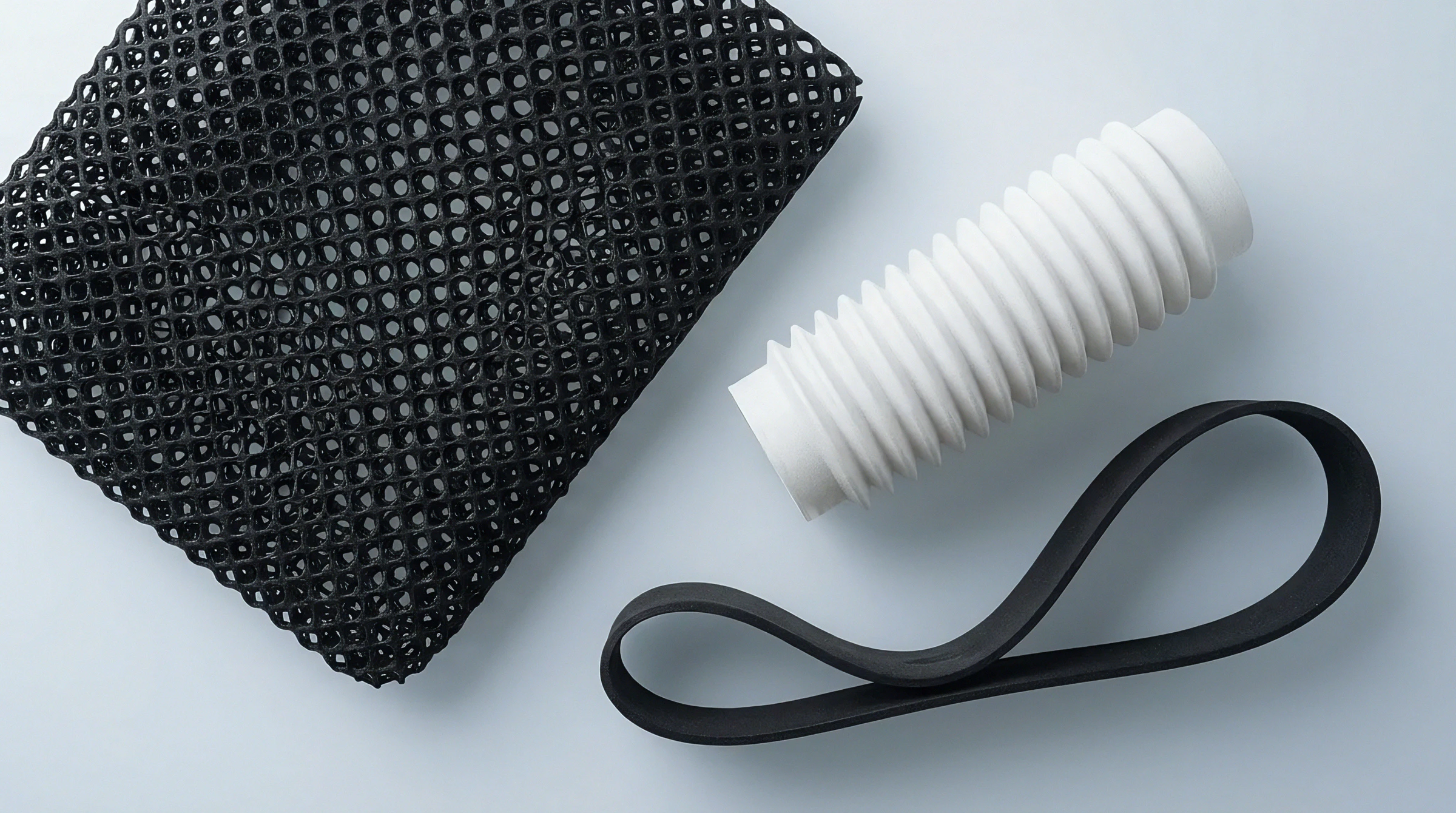
A bar of Ultrasint TPU01 printed flat on an HP Jet Fusion 5200 stretches to 280 % before it breaks. The same powder printed standing up breaks at 150 %. Tensile strength falls less, from 9 to 7 MPa (1,305 to 1,015 psi), and the hardness reads 88 to 90 Shore A on either bar. A flexible part from a powder bed is soft in every direction and stretchy in only two of them, and a datasheet that prints one elongation figure has left out the one a designer of a hinge, a strap or a bellows most needs.
Thermoplastic polyurethane (TPU) is the rubber-like polymer of powder bed fusion. In selective laser sintering (SLS) a laser fuses it; in HP Multi Jet Fusion (MJF) an infrared lamp fuses the areas where an agent has been jetted. The sections below compare the grades their makers publish, read the test methods behind each number, and finish with what a buyer writes into an order for flexible printed parts.
TPU Powder Grades and Their Tensile Properties in XY and Z
Four makers’ sheets give enough to compare. Forward AM, the additive business of BASF, publishes four Ultrasint TPU powders side by side in one brochure, which makes it the cleanest set: the same company, the same tests, four grades. Raise3D and Sinterit each publish one grade for their own machines.
| Grade and machine | Shore A | Tensile strength XY / Z | Elongation at break XY / Z | Tensile modulus |
|---|---|---|---|---|
| Ultrasint TPU01, HP Jet Fusion 5200 | 88 to 90 | 9 / 7 MPa (1,305 / 1,015 psi) | 280 / 150 % | 85 MPa (12,300 psi) |
| Ultrasint TPU 88A, SLS | 88 to 90 | 8 / 7 MPa (1,160 / 1,015 psi) | 270 / 130 % | 75 MPa (10,900 psi) |
| Ultrasint TPU 88A Black, SLS | 86 to 88 | 8 / 5 MPa (1,160 / 725 psi) | 360 / 100 % | 85 MPa (12,300 psi) |
| Ultrasint TPU 90A LT, SLS | 90 | 9 / 7 MPa (1,305 / 1,015 psi) | 280 / 120 % | 110 MPa (15,950 psi) |
| Raise3D TPU 90A Black V1, SLS | 90 | 11.2 MPa (1,624 psi), X only | 248.3 %, X only | Not given |
| Sinterit Flexa Performance, Lisa and Lisa Pro | 86 to 88 | 5.0 MPa (725 psi) | 100 % | Not given |
Sources: Forward AM, TPU Portfolio brochure, Mechanical Properties Comparison; Raise3D, TPU 90A Black V1 Powder Technical Data Sheet v1.0; Sinterit, Flexa Performance Technical Data Sheet. Tensile strength and elongation for Ultrasint grades per DIN 53504, S2; modulus per ISO 527-2, 1A. Raise3D per ISO 527-2; Sinterit per ISO 37.
Read down the elongation column and one pattern holds across every grade that reports both directions. Elongation in Z is between a little over a quarter and a little over half of elongation in XY: 150 against 280 % for TPU01, 100 against 360 % for TPU 88A Black. The black grade has the widest gap of the set, stretching furthest in the plane and least across the layers. Strength falls less than elongation between the two directions, which says the layer interface is where a stretched bar tears first.
Raise3D prints values for the X direction only and marks Y and Z with a slash. Sinterit gives one value with no direction. Neither figure can be compared with a Z row, and neither tells a designer how a part stretched across its layers will behave.
In TPU from a powder bed, hardness is the same in every direction and elongation is not. A flexing feature stretched across the layers sees the lower number.
Shore Hardness, Rebound and Impact in Flexible Parts
Hardness is the property buyers ask for first, because it is the one they know from molded rubber. All the powders here sit between 86 and 90 Shore A. Forward AM measures to DIN ISO 7619-1, Raise3D to ISO 868, Sinterit to PN-EN ISO 868, and two makers state a range rather than a value. Sinterit adds that its hardness depends on printing settings and design.
The narrow hardness band hides wide differences elsewhere. TPU01 lists a rebound resilience of 63 % on Forward AM’s product page, and TPU 90A LT an energy return of 66 % to DIN 53512, the figure a designer of padding or footwear works from. Notched Charpy impact at 23 °C reads “no break” for all four Ultrasint grades in both directions. At −10 °C (14 °F) the product sheets give TPU01 46 kJ/m² in X and 44 kJ/m² in Z (21.9 and 20.9 ft·lbf/in²), and TPU 88A 60 and 58 kJ/m² (28.5 and 27.6 ft·lbf/in²). TPU 88A Black reports no break at −30 °C (−22 °F).
Heat and Softening
Forward AM gives Vicat softening to DIN EN ISO 306, method A at 10 N: 97 °C (206.6 °F) for TPU01, 98 °C (208.4 °F) for TPU 88A and 101.7 °C (215.1 °F) for TPU 88A Black. Vicat is the temperature at which a loaded needle sinks a fixed depth, so it marks where the material gives way under a point load, not where a part stops working. Raise3D and Sinterit leave thermal values out or mark them “n/a”.
A buyer who needs a TPU part to hold its shape near a heat source has no service temperature from these sheets, only a softening point. Only a test on the part, at the temperature and load it will see, can to close that gap.
Five Test Methods Behind the Same Word
The four sheets use different standards for the same property. That is the most common reason two TPU datasheets disagree, and it is easy to miss because every sheet calls the number “tensile strength” or “elongation at break”.
| Maker and sheet | Tensile and elongation | Modulus | Hardness |
|---|---|---|---|
| Forward AM, Ultrasint TPU line | DIN 53504, specimen S2 | ISO 527-2, specimen 1A | DIN ISO 7619-1 |
| Raise3D, TPU 90A Black V1 | ISO 527-2 | Not given | ISO 868-2003 |
| Sinterit, Flexa Performance | PN-EN ISO 37:2007 | Not given | PN-EN ISO 868:2005 |
Sources: the same three makers’ sheets, method columns and footnotes.
DIN 53504 and ISO 37 are rubber test methods, written for elastomers and run on dumbbell specimens that stretch a long way. ISO 527-2 is the plastics tensile method, written for stiffer materials. A TPU tested to each will not give the same numbers, and a sheet that tests strength by one method and modulus by another, as the Ultrasint TPU01 sheet does, reports two figures that were never measured on the same specimen.
The practical rules for reading these sheets are short.
- Compare grades only within one maker’s table, where the method and specimen are the same.
- When two makers are compared, put the method beside each value and treat a gap of a few MPa as possibly the method, not the material.
- Ask for the direction of every tensile value. A value without one is usually X or XY.
- Ask whether the specimens were printed or cut, and at what position in the build, since every maker notes that geometry, orientation and conditions change the result.
Raise3D’s disclaimer puts it plainly: its typical values are for reference and comparison, not for design specifications or quality control, and actual values may vary significantly with printing conditions. Sinterit says its figures are averages from prints on its own Lisa printers. Forward AM presents its values as guidance based on its own knowledge and experience.
A TPU datasheet compares grades from one maker. It does not set a tolerance on a part, and its makers say so in the footnotes.
Refresh Ratio and Powder Reuse in TPU Builds
In a powder bed, most of the powder in the chamber never becomes a part. It is heated for hours, sieved and mixed with new powder before the next build. The share of new powder each build needs, the refresh ratio, decides how much material a run of parts consumes and how the surface of the parts holds up from build to build.
| Powder | Process | Refresh rate, used to new |
|---|---|---|
| Ultrasint TPU01 | MJF | 80 / 20 |
| Ultrasint TPU 88A and TPU 88A Black | SLS | 80 / 20 |
| Ultrasint TPU 90A LT | SLS | 80 / 20 |
| Ultrasint PA11, conditioned | SLS and MJF | 50 / 50 |
| Ultrasint PP 1400 Black | SLS | 60 / 40 |
| Sinterit Flexa Performance | SLS, Lisa series | 20 % new, extra 50 % refresh when surface quality drops |
Sources: Forward AM, TPU Portfolio brochure, Sustainability Summary; Sinterit, Flexa Performance sheet, general information and footnotes 1 to 3.
The Forward AM figures are the minimum share of new powder needed to keep its best print quality, and the brochure marks them as typical. It lists what moves them: the machine type and technology, the process parameters, how intensively the material is used, packing density, part geometry and the properties each part needs. The TPU grades tolerate more reuse than the nylon and polypropylene grades in the same table.
Sinterit’s footnote is the more candid line for a buyer planning a run. Its Flexa powder takes 20 % new powder per build, and it may need an additional refresh at 50 % when the surface quality drops, which it says can happen every few to more than a dozen prints. A batch spread over many builds can therefore show a step in surface quality partway through, and a supplier who refreshes heavily at that point resets it.
Powder Density and Packing
Raise3D gives three densities for its TPU 90A Black: 1.055 g/cm³ (0.0381 lb/in³) for the material to ISO 1183-1, 0.332 g/cm³ (0.0120 lb/in³) as the powder bed density, and 0.464 g/cm³ (0.0168 lb/in³) as bulk density to ISO 60 and ASTM D1895. The bed holds roughly a third of the material’s solid density, and the rest of the volume is air between particles. Sinterit gives a particle size of 70 to 90 µm (0.0028 to 0.0035 in) to ISO 13320 and leaves printed density as “n/a”.
Which TPU Powder Runs on Which Machine
TPU is not one powder that runs everywhere. Each grade is tuned to the way a machine fuses it, and the makers say which machines they cover.
- Ultrasint TPU01 is designed for HP’s 52XX and 56XX series Multi Jet Fusion printers, according to Forward AM’s product page, and the brochure lists the HP 5200 series as its machine.
- Ultrasint TPU 88A and TPU 90A LT are listed for SLS machines from Farsoon, EOS, 3D Systems and XYZprinting, some of them with an open parameter kit.
- TPU 88A Black adds desktop SLS machines to that list.
- Flexa Performance is tested on Sinterit’s own Lisa and Lisa Pro printers and needs no nitrogen.
- Raise3D publishes its TPU 90A Black without naming the machines its values came from.
A buyer who has a part qualified in one grade on one machine family has qualified that pair. Moving the same file to another process, even another TPU at the same Shore hardness, changes the fusing, the shrink and the elongation, as Table 1 shows between TPU01 on MJF and TPU 88A on SLS. Forward AM describes TPU01 as having high process stability and one of the highest throughputs among flexible materials, and positions it for serial production on MJF; those are the maker’s words about its own powder, and a run plan tests them on the supplier’s machine.
A TPU part is qualified on a grade, a machine family and a parameter set. Change any one of them and the first parts of the next lot are first parts again.
Seals, Grips and Lattices From TPU Powder
The makers’ application lists show where they expect the material to work, and they overlap closely. Sinterit names gaskets, flexible joint covers, vibration dampers, shoe soles and insoles, vehicle cover elements, seals and production tools. Raise3D names soles and insoles, phone cases, seals, snap buckles, gaskets, bellows, flexible joints, piping, cushioning pads, helmet liners and elastic lattices. Forward AM names sports protection, footwear, orthopedic models, car interior components, grippers and pipes, and offers lattice design for TPU parts.
Three kinds of part run through those lists, and each leans on a different row of the datasheet.
- Seals, gaskets and covers work in compression. Hardness and the recovery of the material matter most, and none of the four powder sheets here gives a compression set, so that value is asked for or tested.
- Grips, straps, hinges and bellows work in tension and bending. Elongation in the direction of the flex is the row to read, and Table 1 shows how much it depends on orientation.
- Pads, insoles and lattices work by structure as much as by material. Rebound and energy return figures belong to the solid material; a lattice of the same powder behaves according to its cells, which is why Forward AM offers lattice engineering alongside the powder.
Raise3D’s sheet lists resistance to saltwater stress cracking, hydrolysis and UV exposure among its benefits. Forward AM’s brochure marks UV stability to ISO 4892-2 and hydrolysis resistance among the tests with a statement available for its TPU line. Those are the makers’ statements on their powders, and an outdoor or wet application is checked against them before it is ordered. A printed TPU seal is usually a step toward a production seal in molded rubber or a thermoplastic elastomer, and the hardness and set figures above are what it is compared with when that tool is ordered.
Finishing Flexible Powder Bed Parts
Parts come out of the powder cake with a matte, slightly grainy skin. The Forward AM brochure lists three finishing routes it marks as compatible with the TPU line: chemical smoothing for all four TPU grades, its Ultracur3D Coat F+ flexible two-component waterborne basecoat for the grades it names, and liquid dyeing, which it says reaches all surfaces including small cavities, lattices and hollowed parts.
The brochure states that both mechanical and chemical smoothing improve surface roughness and overall quality, and Forward AM’s product page points to two whitepapers on TPU01, one on vapor smoothing with the PostPro system and one with DyeMansion on post-processing. It gives no roughness value in the brochure itself, so a buyer who needs a sealing face or a skin-contact surface of a given finish asks the supplier for measured Ra on smoothed samples of the same grade.
Two finishing questions belong in the order.
- Is smoothing allowed, and on which faces? Smoothing changes the surface and can soften small edges.
- Is the part dyed, coated or left natural? A coating adds a layer the flexing part has to carry, and the brochure describes Coat F+ as made to flex with elastic printed materials.
Ordering TPU Parts From SLS or MJF
The sheets above lead to a set of lines that keep a flexible printed part from changing between lots.
- Name the grade and the process together: Ultrasint TPU01 on MJF is not TPU 88A on SLS, though both read 88 to 90 Shore A.
- Mark the build direction for any feature that stretches or flexes, and state which direction the elongation requirement applies to.
- Give hardness with its standard and allow for the range the maker publishes.
- Ask for tensile bars from the same build, tested by the method the maker used, in the direction that matters.
- State the refresh practice or ask the supplier for it, and ask to be told when a heavy refresh is made partway through a batch.
- Write the finish per face: as printed, smoothed, coated or dyed.
The softness of TPU makes many of these parts gaskets, grips, pads and covers, where the fit comes from the material yielding. Those datasheets support that use in the plane of the layers; across the layers, they say elongation is roughly halved. For a buyer weighing low-volume 3D printing of flexible parts against molded rubber for bridge production, the build direction written on the drawing is the line that keeps the printed part close to what the molded part will later do.
Sources and Further Reading
- Forward AM TPU Portfolio, Powders and Filaments, 2024, BASF Forward AM
- Ultrasint TPU01 Polymer Powder for 3D Printers, Forward AM
- TPU 90A Black V1 Powder Technical Data Sheet v1.0, April 2026, Raise3D
- Flexa Performance, Material’s Technical Data Sheet, 27 February 2023, Sinterit