Hardness

Hardness is a material's resistance to indentation, given on printed polymers as a Shore D number.

Every Hardness article of the 3D Printing Resources, newest first, each written from published standards, research and makers’ data.

Meaning

Hardness is a material’s resistance to indentation, given on printed polymers as a Shore D number. Datasheets measure it to ISO 7619-1 or to ASTM D2240, both on the Shore D scale. It is one of the few rows most polymer and resin sheets in these resources share. It sits beside the tensile and impact rows and does not replace them.

Shore D Values

EOS PA 2200 gives Shore D 75 under ISO 7619-1. HP’s glass bead PA 12 gives 82 under ASTM D2240, and HP’s plain PA 12 sheet publishes none. Among tough resins, Accura Xtreme gives 86, Somos EvoLVe 128 gives 82 and Accura 25 gives 80. The Formlabs Tough 2000 Resin V2 page publishes no hardness.
Read More

Methods

The method tables behind ISO/ASTM 52927 show the split in families. EOS uses ISO 7619-1, and HP and 3D Systems use ASTM D2240. Both report on Shore D, but a buyer compares a figure with another from the same method where the two are available.

Duty Ranking

Hardness does not rank grades for a duty. Accura Xtreme shows the highest Shore D of the tough resins and stretches 14 to 22 %. Tough 2000 Resin V2 stretches 79 % and publishes no hardness at all. A part’s duty is read on the row that governs it, elongation for a hinge and notched impact for a sharp corner.

Hardness Requirement

Where hardness is a requirement, the order names the scale, the method and the cure or build condition of the specimen. For a resin part, the figure holds only after the post-cure the maker names.
Vapor Smoothing and Bead Blasting SLS Nylon Parts

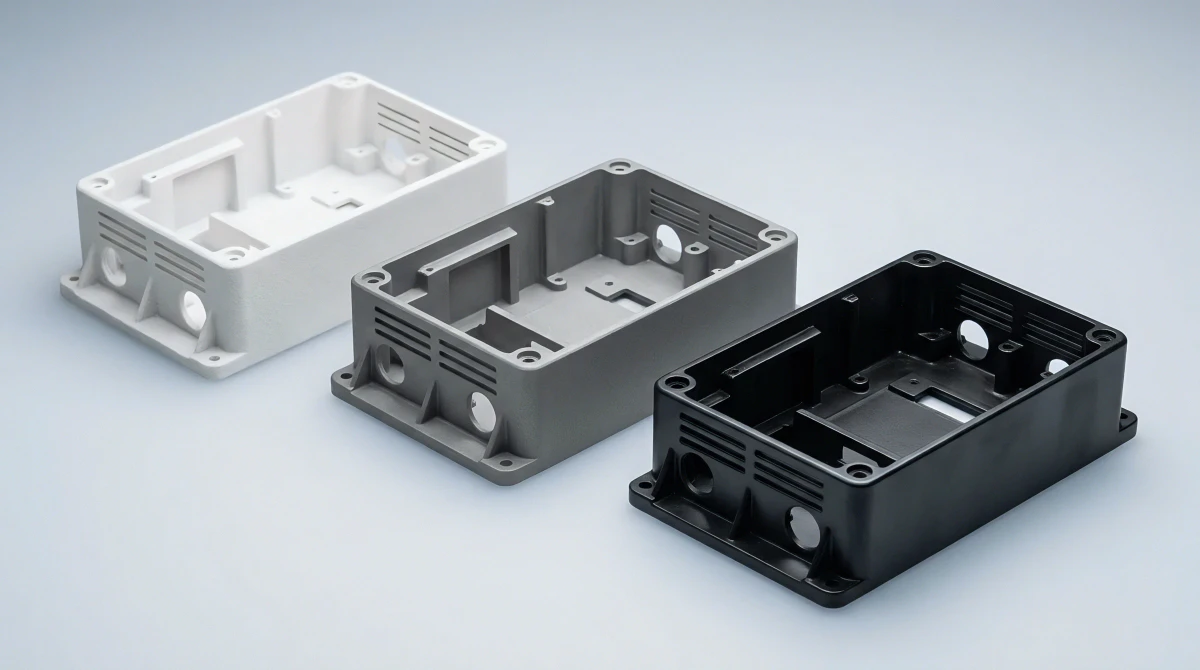
Powder bed nylon is always bead blasted clean, then optionally shot surfaced for feel and color or vapor smoothed for a sealed glossy skin, and the order names the steps and the faces.

The Finishing Sequence for Powder Bed NylonThe DyeMansion test that opens this piece ran every part through the same steps, and its table of settings is the clearest published version of the sequence.

TPU Flexible Powder for SLS and MJF Parts

TPU from a powder bed is equally soft in every direction but stretches far less across its layers, so grade, machine, build direction and test method all belong in the order.

TPU Powder Grades and Their Tensile Properties in XY and ZFour makers' sheets give enough to compare. Forward AM, the additive business of BASF, publishes four Ultrasint TPU powders side by side in one brochure, which makes it the cleanest set: the same company, the same tests, four grades.

AlSi10Mg Aluminum Properties in Laser Powder Bed Fusion

Printed AlSi10Mg is stronger than the cast alloy as built, and the heat treatment named on the order decides how much strength is traded for ductility or conductivity.

AlSi10Mg Tensile and Yield Strength by Heat TreatmentThe first answer a buyer needs is the strength in each state the material is delivered in. Two makers publish it for their own systems and parameters, and their numbers are close enough to read together and different enough to show why the state and the source both travel with a figure.

ISO/ASTM 52927 Main Characteristics and Test Methods for AM Parts

The test methods standard links the characteristics of additive feedstock and parts to test procedures, and a buyer fixes the method, specimen, orientation and statistical basis in the order.

What ISO/ASTM 52927 Covers and Who It Is ForThe scope states that the document specifies the principal requirements applied to the testing of parts produced by additive manufacturing processes. It does three things.

Tough SLA Resins as Stand-Ins for ABS and Polypropylene

Tough SLA resins match ABS on stiffness and strength but not on fracture energy or heat, so a part needs the row that governs its duty.

What a Tough SLA Resin Is Meant to ReplaceA tough SLA resin is a photopolymer that cures under ultraviolet light into a solid that bends before it breaks. Its makers aim it at the parts where earlier SLA resins cracked: snap fits, hinges, housings that are dropped and jigs that get clamped.

PA12 Nylon Properties for SLS and MJF Parts

Powder-bed nylon parts stretch far less along the build axis than in the layer plane, so a drawing needs a build direction, a grade and the test method.

What PA12 Powder Gives a Printed PartPolyamide 12 is the base polymer of the most common powders for laser sintering and for HP Multi Jet Fusion. EOS describes PA 2200, its PA12 powder, as a balanced property profile and "the most proven material on the market" for its machines.

Send the 3D File of Your Printed Part

Send the 2D drawing and the 3D file, with the quantity and the stage of the project. An engineer replies within 1 working day.

The quote form, the mutual NDA and the private folder for your files are on Protolis Atelier, with 3D Printing chosen.

Request a Quote