One EOS data sheet for PA 2200 prints the same tensile test three times and gets three answers. Pulled along the X or Y axis of the build, the powder-bed part stretches 18 % before it breaks. Pulled along Z, the direction the layers stack, the same polyamide 12 stretches 4 %. The strength drops only from 48 MPa (6,960 psi) to 42 MPa (6,090 psi), so a buyer who reads the strength row alone sees a nearly isotropic material, and a buyer who reads the elongation row sees a part that can snap where a molded one would bend.
That gap is the first thing to understand about PA12 in a powder bed. The second is that “PA12” names a polymer, not a property set: EOS, HP and the other powder makers each sell a grade with its own melting point, refresh rule and test method. The sections below put the published figures of three grades side by side, say what the build direction does to them, and list what a datasheet does not promise.
What PA12 Powder Gives a Printed Part
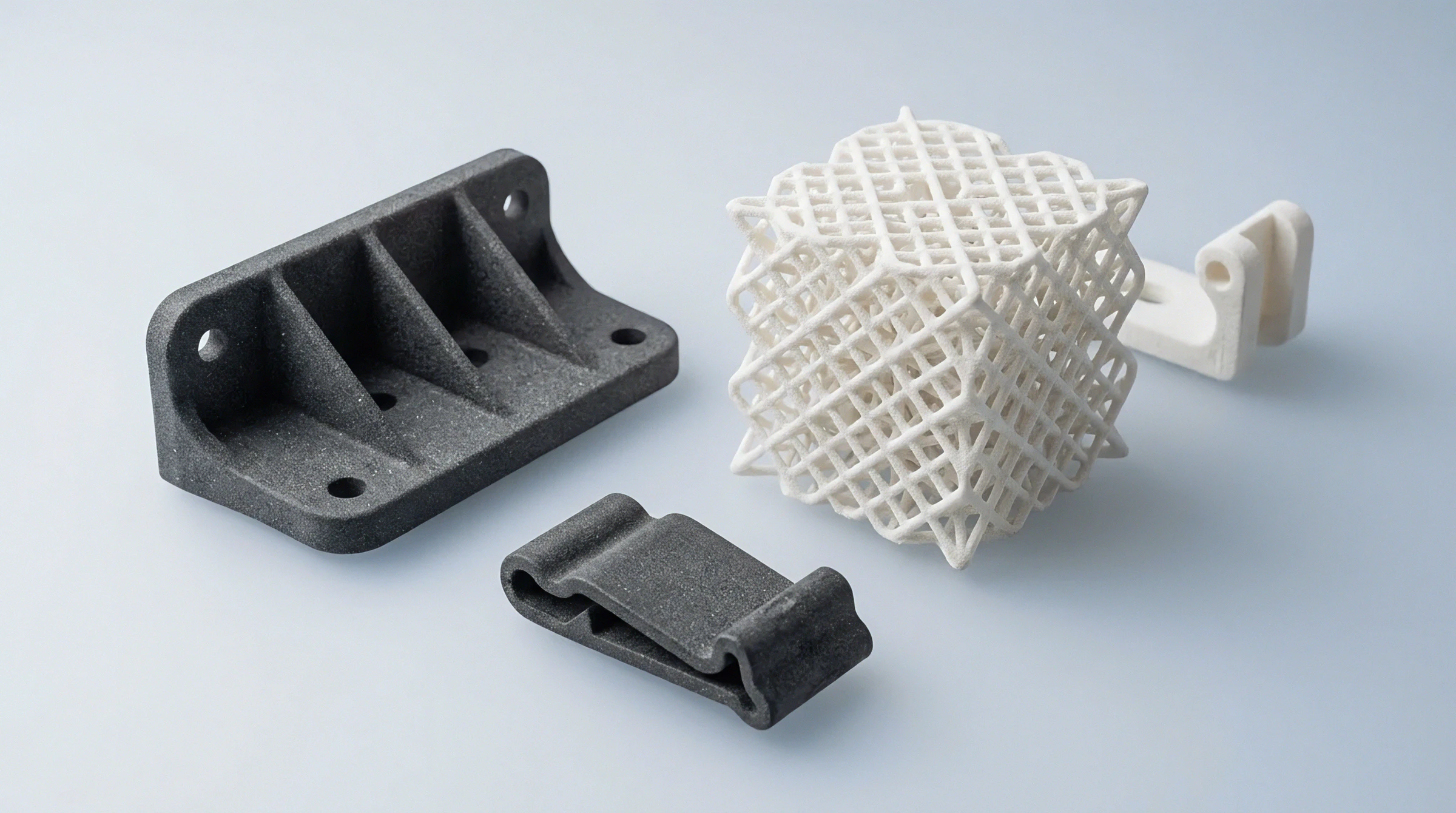
Polyamide 12 is the base polymer of the most common powders for laser sintering and for HP Multi Jet Fusion. EOS describes PA 2200, its PA12 powder, as a balanced property profile and “the most proven material on the market” for its machines. Parts come out white in the EOS grade, and the unfused powder around them acts as the support during the build.
Three consequences follow for a buyer.
- The part is built from fused powder, and each maker’s figures belong to its own powder, machine and parameter set, not to PA12 in general.
- HP shows its parts after dye and graphite post-processing and calls the grade suited to post finishing, so a colored or smoothed surface is a finishing step, not the as-built state.
- The properties depend on the axis, because each layer bonds to the one below by a thermal fusion step that is weaker than the bonds inside a layer.
PA12 in a powder bed is a family of grades whose figures are not interchangeable. A property is only comparable when the maker, the build direction and the test method match.
EOS prints a disclaimer on the same sheet: part properties are given for information only, and the properties a user achieves depend on many influencing factors. HP carries equivalent language on its sheets. The figures are typical values from the maker’s own build, not an acceptance limit for a delivered part, and the section on datasheets at the end says how to turn them into one.
PA12 Properties Compared by Maker and Grade
Table 1 sets three published grades against each other on the mechanical rows they share. The grades are EOS PA 2200 at its Balance parameter set (120 µm layers), HP 3D High Reusability PA 12, and HP 3D High Reusability PA 12 Glass Beads, which is filled with 40 % glass beads.
| Property | EOS PA 2200 (ISO) | HP HR PA 12 (ASTM) | HP HR PA 12 GB (ASTM) |
|---|---|---|---|
| Tensile modulus, X or XY | 1,650 MPa (239 ksi) | 1,700 MPa (245 ksi) | 2,500 MPa (363 ksi) |
| Tensile modulus, Z | 1,650 MPa (239 ksi) | 1,800 MPa (260 ksi) | 2,700 MPa (392 ksi) |
| Tensile strength, X or XY | 48 MPa (6,960 psi) | 48 MPa (6,960 psi) | 30 MPa (4,351 psi) |
| Tensile strength, Z | 42 MPa (6,090 psi) | 48 MPa (6,960 psi) | 30 MPa (4,351 psi) |
| Elongation at break, X or XY | 18 % | 20 % | 10 % |
| Elongation at break, Z | 4 % | 15 % | 10 % |
| Flexural modulus | 1,500 MPa (218 ksi) | not published | 2,400 MPa XY, 2,700 MPa ZX (348 and 392 ksi) |
| Shore D hardness | 75 | not published | 82 |
| Part density | 0.93 g/cm³ (EOS method) | 1.01 g/cm³ (ASTM D792) | 1.3 g/cm³ (ASTM D792) |
Sources: EOS material data sheet PA 2200, test standard ISO 527-1/-2 for the tensile rows, ISO 178 for flexure, ISO 7619-1 for hardness; HP data sheets 4AA6-4895ENA (February 2017) and 4AA7-0716ENE (January 2019), ASTM D638 type V specimens, ASTM D790 for flexure and ASTM D2240 for hardness.
Three cautions apply before anyone ranks the columns.
First, EOS reports ISO 527 results and HP reports ASTM D638 results on a type V specimen. The two procedures differ in specimen size and in test speed, and HP states the speeds it used: 1 mm/min for the Z specimens and 10 mm/min for the XY specimens. A strength compared across the two makers is a comparison of two procedures as much as two powders.
Second, the density rows do not measure the same thing. EOS lists 0.93 g/cm³ by its own method and HP lists 1.01 g/cm³ by ASTM D792. Nobody should read the difference as one grade being 8 % lighter.
Third, the HP PA 12 sheet gives the Z-axis modulus as 1,800 MPa against 1,700 MPa in XY. The Z direction is slightly stiffer there, and slightly less stretchy, which runs opposite to the intuition that the layer boundary is simply a weak plane.
Why Elongation Falls Along the Build Axis
The Z elongation on the EOS sheet is 4 %, which is 22 % of the 18 % measured in the layer plane. HP’s PA 12 gives 15 % against 20 %, or 75 %. Both makers measure strength within 13 % of the XY figure, so the loss is concentrated in how far the part stretches rather than how hard it pulls.
The usual explanation is the layer bond. A specimen pulled along Z loads the interfaces between layers in tension, and a flaw in one interface can start a crack that runs along the layer, while a specimen pulled along X or Y loads continuous fused paths. The ratio between the two directions then says something about how well a machine and its parameters bond a layer, which fits the same polymer showing 4 % on one maker’s sheet and 15 % on another’s.
Orientation is named in the test report by a convention. HP states that its orientations follow ASTM F2971, the practice for reporting data on test specimens prepared by additive manufacturing, and ISO/ASTM 52921 is the terminology document that defines machine coordinate systems and the location and orientation of parts.
Reading the Axis Letters on a Part Drawing
A drawing that carries a load on a snap hook or a living hinge should state which way the part is built, because the grade that gives 18 % elongation in one orientation gives 4 % in another. The common ways to say so are a build-direction arrow on the drawing and a note that the long axis of the hook lies in the XY plane. Without it a supplier orients the part for packing density and cost, which is a defensible choice that can still place the highest strain across the weakest bond.
A worked case shows the scale, with an assumed strain. Take a cantilever snap hook that strains 2.5 % at assembly. Against the EOS typical break strains, the XY figure of 18 % leaves a ratio of about 7 to 1, and the Z figure of 4 % leaves about 1.6 to 1. Because the sheet quotes typical values and not a lower bound, the real margin in Z is thinner than 1.6. The hook that passes in one orientation can crack on the first assembly in the other. When a printed PA12 part is a step toward a molded one, the comparison is with nylon that will be injection molded later, and the build-axis figures here are the ones that have no counterpart in a molded part.
Strength moves little with build direction. Elongation moves a great deal. A part that relies on stretch needs its build direction written down.
Heat Deflection, Melting and Flammability of PA12
Powder-bed PA12 melts in a narrow window, and its in-service temperature limit is far below that melting point. Table 2 lists the thermal rows the three sheets publish.
| Property | EOS PA 2200 | HP HR PA 12 | HP HR PA 12 GB |
|---|---|---|---|
| Melting temperature | 176 °C (349 °F), ISO 11357 | 187 °C (369 °F), ASTM D3418 | 186 °C (367 °F), ASTM D3418 |
| Heat deflection at 0.45 MPa | 157 °C (315 °F) in X, 145 °C (293 °F) in Z | 175 °C (350 °F), Z | 174 °C (345 °F) XY, 175 °C (347 °F) ZX |
| Heat deflection at 1.8 MPa | 64 °C (147 °F) in X, 57 °C (135 °F) in Z | 95 °C (203 °F) at 1.82 MPa, Z | 114 °C (237 °F) XY, 120 °C (248 °F) ZX at 1.82 MPa |
| Vicat softening, B50 | 176 °C (349 °F) | not published | not published |
| UL 94 | HB at 0.5, 1.6 and 3.2 mm | not published in the sheet | listed under UL 94 and UL 746A certifications |
Sources: EOS PA 2200 material data sheet; HP data sheets 4AA6-4895ENA and 4AA7-0716ENE. The HP rows use ASTM D648; the EOS rows use ISO 75-1/-2.
The two load levels of heat deflection temperature (HDT) tell different stories. At 0.45 MPa, a light load, EOS and HP grades hold their shape past 145 °C. At 1.8 MPa, a load closer to a bracket carrying a real weight, the EOS grade softens at 64 °C and the glass-filled HP grade at 114 °C. A part for an engine bay or a hot enclosure has to be read against the heavy-load row, not the light one.
Note also the difference between the two HP grades at the 1.82 MPa load. The plain grade gives 95 °C. The glass-bead grade gives 114 °C to 120 °C, a gain of 19 to 25 °C that comes from the filler.
EOS lists UL 94 HB for PA 2200 at three thicknesses, 0.5, 1.6 and 3.2 mm. HB is the lowest of the UL 94 horizontal burn classes, so it is a statement about burning rate, not about self-extinguishing. The same sheet gives a comparative tracking index of 600 V or more by IEC 60112. A buyer who needs a V-0 rating or a flame-retardant grade needs a different powder, and the datasheet of that powder, not this one.
Glass Bead Filled PA12 Trades Elongation for Stiffness
HP’s glass bead grade is 40 % glass bead filled PA12. Table 3 subtracts the two HP grades row by row, using only the figures printed in the two sheets.
| Property | HR PA 12 | HR PA 12 GB | Change |
|---|---|---|---|
| Tensile modulus, XY | 1,700 MPa | 2,500 MPa | up 47 % |
| Tensile modulus, Z | 1,800 MPa | 2,700 MPa | up 50 % |
| Tensile strength | 48 MPa | 30 MPa | down 38 % |
| Elongation at break, XY | 20 % | 10 % | halved |
| Elongation at break, Z | 15 % | 10 % | down 33 % |
| Heat deflection at 1.82 MPa, Z | 95 °C | 120 °C | up 25 °C |
| Part density | 1.01 g/cm³ | 1.3 g/cm³ | up 29 % |
Stiffness and heat resistance rise by roughly half and a quarter. Strength falls by more than a third, elongation by a third to a half, and the part gets heavier. HP positions the filled grade for enclosures, housings, fixtures and tooling, where stiffness and dimensional stability matter and large strain does not. The grade also loses the anisotropy in elongation: 10 % in both XY and Z.
A buyer choosing between the two grades is choosing a failure mode. The unfilled grade bends and survives a drop. The glass-filled grade holds a fixture’s shape under a clamp and breaks at a lower strain.
Powder Reuse and Why Parts Differ Between Builds
Powder that was not fused is sieved and used again, but it ages in the printer. HP publishes two refresh rules. For HR PA 12 it states stable performance at a 20 % refresh rate, which it expresses as 80 % reusability. For the glass-filled grade it gives a minimum refresh ratio of 30 % and up to 70 % reusability. A refresh rate is the share of fresh powder in the next mix, so a 30 % rule means that no more than 70 % of the mix is surplus powder from earlier builds.
For a purchasing engineer, the refresh rule explains why a single batch of powder is never one material. HP states that its data come from powder aged in real printing conditions and tracked by generation, with parts made and tested from each generation, and it calls that the worst case for reusability. A supplier running at or above the refresh ratio can stay inside the sheet, and the sheet then describes the least favorable generation in the test, not an average one.
HP also gives a recommended relative humidity of 50 to 70 % RH for the glass-bead powder. A powder that has taken up moisture behaves differently on the next build, which is one of several reasons a part from last week’s batch and a part from this week’s batch need a measured comparison and not an assumption.
What the Sheets Leave Out
None of the three sheets publishes creep, fatigue, a chemical resistance table by medium, or a tolerance interval with a confidence level. HP’s HR PA 12 sheet claims good resistance to oils, greases, aliphatic hydrocarbons and alkalies, but no concentration, temperature or exposure time. The EOS sheet carries a statement that the powder is not developed or certified as a medical device under Regulation (EU) 2017/745, and it puts all responsibility for any medical use on the user. A buyer asking for medical, food contact or flame-retardant use needs the declarations of the part’s maker, in writing, for the exact grade and build parameters.
Writing a PA12 Specification That a Supplier Can Sign
A datasheet row becomes a requirement when a buyer attaches a condition to it. The notes below turn the figures above into lines for a drawing or a purchase order.
- Name the powder by maker and grade, for example EOS PA 2200 or HP 3D High Reusability PA 12, and not “nylon” or “PA12”. Add the parameter set or print mode where the maker names one, such as Balance at 120 µm.
- State the build orientation of the critical features and write which axis carries the load. If the part carries a snap or hinge, require the long axis in the XY plane.
- Ask for the test method and the specimen orientation with every figure, in the form the maker uses: ISO 527 or ASTM D638, X, Y or Z.
- Ask which powder generation was used, or the refresh ratio, when a part will be compared against an earlier batch.
- Read the heat row at the load the part carries. A bracket at 1.8 MPa is a 64 °C part in the EOS grade, not a 157 °C part.
- Ask in writing for any ratings, such as UL 94 V-0 or a medical declaration, as a claim of the part’s maker and not an inference from the powder.
Conditions written this way let the second batch be compared with the first, which is the step a buyer needs when a handful of printed parts turns into a series. A buyer weighing low-volume 3D printing against a molded tool for bridge production can hold the printed parts to the same written conditions from the first lot to the last.
Sources and Further Reading
- EOS GmbH, Material Data Sheet PA 2200, Balance parameter set, status 17.11.2026. https://www.eos.info/polymer-solutions/polymer-materials/data-sheets/mds-pa-2200
- HP Development Company, HP 3D High Reusability PA 12 data sheet, document 4AA6-4895ENA, February 2017. https://www.hp.com/go/3DMaterials
- HP Development Company, HP 3D High Reusability PA 12 Glass Beads data sheet, document 4AA7-0716ENE, January 2019. https://www.hp.com/go/3DMaterials
- HP, Jet Fusion 5200 3D printer product page, list of compatible materials. https://www.hp.com/us-en/printers/3d-printers/products/multi-jet-fusion-5200.html
- ASTM International, F2971 Standard Practice for Reporting Data for Test Specimens Prepared by Additive Manufacturing, store page. https://store.astm.org/f2971-13r21.html
- ASTM International, F2921 / ISO/ASTM 52921 Standard Terminology for Additive Manufacturing, Coordinate Systems and Test Methodologies, store page. https://store.astm.org/f2921-13r19.html