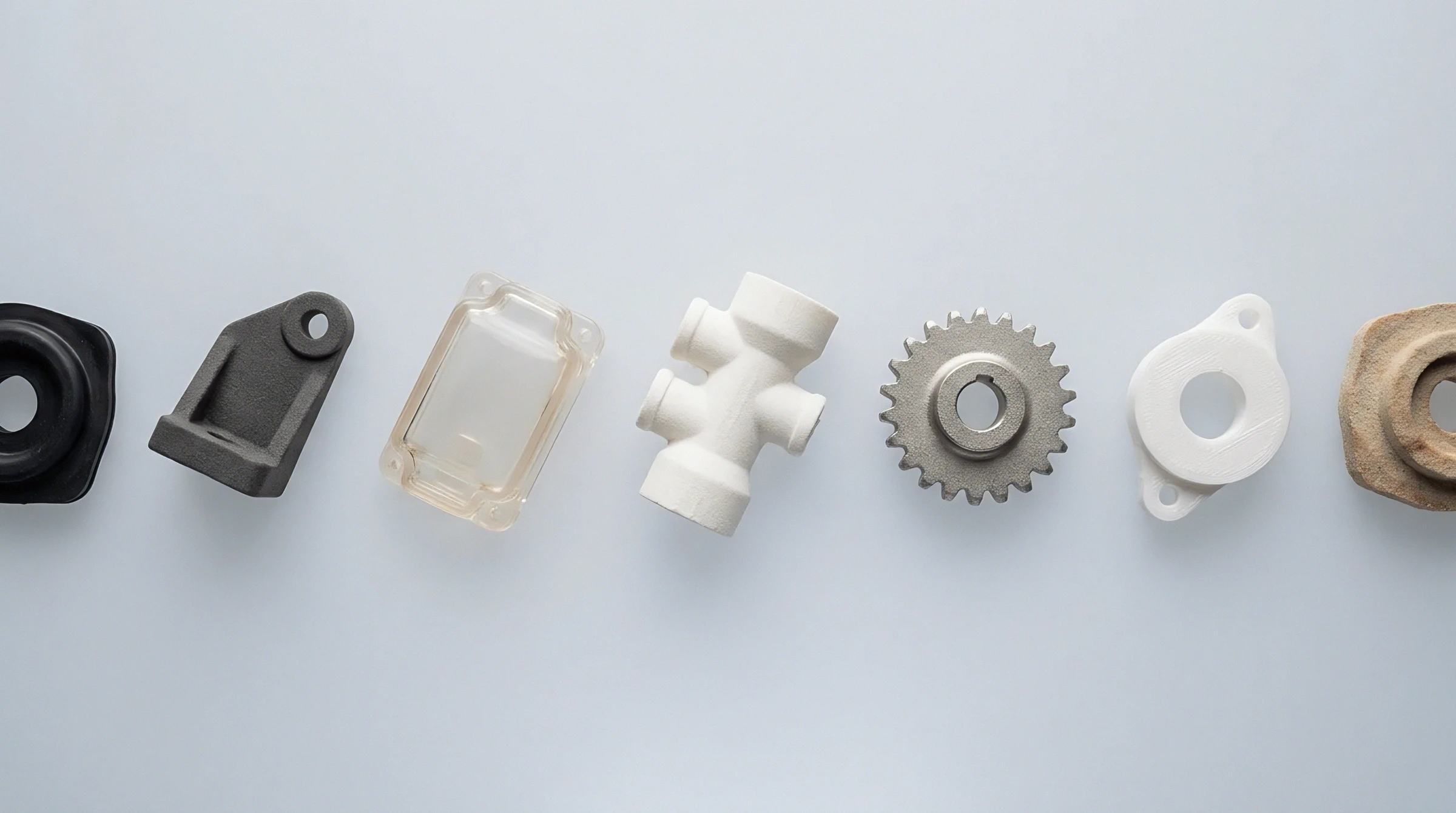
The second edition of ISO/ASTM 52900 carries twelve groups of defined terms, a normative annex for identifying processes and an informative annex on basic principles, and in all of it only two of the seven process categories get a clause of their own for processing terms: material extrusion and powder bed fusion. The index sits on page 26 of the ISO text. A buyer who has never opened it is usually using its words anyway, because every supplier quote that says “powder bed”, “vat” or “extrusion” is borrowing from it.
The document is a vocabulary. It sets no tolerance, names no material and gives no pass mark for a delivered part. What it does is fix the meaning of the words an order is written in, and that is a narrower and more useful job than the title suggests. The sections below read the standard for a buyer: what it covers, how its seven categories divide the field, how the trade names on a quote map onto them, and what it leaves for other standards.
What ISO/ASTM 52900 Covers and What It Leaves Out
ISO/ASTM 52900 establishes and defines the terms used in additive manufacturing (AM), the technology that applies an additive shaping principle and builds physical three-dimensional geometries by successive addition of material. Its scope sentence also states that the terms are classified into specific fields of application. It lists no normative references, so the document stands on its own.
Its introduction explains why it exists. Additive manufacturing is the general term for technologies that successively join material to create physical objects as specified by 3D model data, and the technologies serve engineering industry as well as medicine, education, architecture, cartography, toys and entertainment. During development many terms and definitions came into use, often tied to an application area or a trademark, and the introduction calls that ambiguous and confusing. The stated objective is to ease communication among the people involved worldwide.
Three limits follow from that scope.
- The standard defines words. It does not say what quality a process delivers, so “powder bed fusion” on a quote tells you the family of the machine and nothing about the density, strength or accuracy of the parts.
- It does not select a process for a part. The choice between categories rests on material, geometry, finish and quantity, which are decisions for the buyer and the supplier.
- It does not define supplier qualification, inspection or acceptance. Those sit in other documents of the same family, covered in the last section.
A vocabulary standard fixes what a word means in an order. It does not fix what a part is worth, and a buyer who treats it as a quality mark has read it wrongly.
The Seven Process Categories Named in ISO/ASTM 52900
The standard classifies additive manufacturing processes into seven categories. The Savonia University of Applied Sciences 3D printing page, which cites SFS-EN ISO/ASTM 52900:2021, lists them as follows. The foreword of the second edition confirms that abbreviations were added for seven process categories.
| Category | Where a buyer meets it | Processes named in the opened sources |
|---|---|---|
| Material extrusion | quotes for filament parts | fused deposition modeling (FDM), as described in the Formlabs tolerance guide |
| Material jetting | quotes for jetted photopolymer parts | not covered by an opened source |
| Binder jetting | quotes for bound powder parts | not covered by an opened source |
| Sheet lamination | quotes for laminated sheets | not covered by an opened source |
| Vat photopolymerization | quotes for resin parts | stereolithography (SLA) and digital light processing (DLP) |
| Powder bed fusion | quotes for powder parts | selective laser sintering (SLS), HP Multi Jet Fusion (MJF), EOS DMLS and laser powder bed fusion of metal |
| Directed energy deposition | quotes for large metal builds and repairs | not covered by an opened source |
Sources: Savonia University of Applied Sciences, 3D-printing processes page, which cites SFS-EN ISO/ASTM 52900:2021 for the seven categories; the Formlabs tolerance guide for the plastic process names; EOS and HP product pages for the powder bed names.
The sources read for these resources cover three of the seven in detail: vat photopolymerization, powder bed fusion and, in passing, material extrusion. Material jetting, binder jetting, sheet lamination and directed energy deposition are named by the standard and are not walked through here.
Why Powder Bed Fusion Gets Its Own Clause
The standard’s contents give processing terms to material extrusion in clause 3.7 and to powder bed fusion in clause 3.8, and to no other category. A buyer cannot read much into the choice, because the contents list headings only. What can be said is that powder bed fusion has a vocabulary of its own, which fits how powder bed makers write: the Formlabs guide describes unfused powder supporting the part, and HP’s datasheets describe refresh ratio and powder reuse.
When a Process Does Not Fit One Category
Savonia notes that not every additive process fits neatly into the seven categories and that some could belong to several, because the field develops quickly. It adds that hybrid processes, which combine additive processes with each other or with subtractive manufacturing, do not fit under any one category. A supplier whose process is a hybrid cannot be sorted by category, and the buyer asks instead for the sequence of operations.
How Trade Names on a Quote Map to the Categories
A quote seldom says “powder bed fusion”. It says SLS, MJF, DMLS, SLA, DLP or FDM, and each of those is a brand, an acronym or a machine maker’s term that sits under one of the categories above. Table 2 shows the mapping the opened sources support.
| Name on the quote | Category | What the source says it does |
|---|---|---|
| SLA, DLP | vat photopolymerization | a liquid resin is exposed to a light source and forms thin solid layers (Formlabs) |
| SLS | powder bed fusion | a laser fuses powder into solid parts; unfused powder supports the part (Formlabs) |
| MJF | powder bed fusion | a fusing lamp fuses powder; HP’s Multi-Agent printing process (Formlabs, HP) |
| DMLS, laser powder bed fusion | powder bed fusion | a 400 W fiber laser melts metal powder in an inert atmosphere (EOS M 290 brochure) |
| FDM | material extrusion | a nozzle extrudes thermoplastic filament layer by layer (Formlabs) |
Sources: Formlabs, Guide to 3D Printing Tolerances, Accuracy, and Precision; HP, Jet Fusion 5200 product page; EOS, EOS M 290 brochure.
Three practical points sit in that table.
- Different names sit inside one category. SLS and MJF both belong to powder bed fusion and differ in their heat source, a laser in one and a fusing lamp in the other. Formlabs gives the same tolerance of ±0.5 % or 0.3 mm, whichever is larger, for both, which reflects a shared family and not a promise from either maker.
- A brand name is not a specification. “DMLS” is a registered trademark of EOS for its laser metal process, and a supplier who runs another maker’s machine may use another term. A buyer who writes the category into the drawing, powder bed fusion of metal, leaves the supplier free to run its own equipment and keeps the requirement the same.
- Within a category, materials and parameter sets still differ by maker. The EOS 316L sheet reports its mechanical values per machine and layer thickness, and states that its tolerance intervals are not directly transferable to other systems.
The Layout of the Standard Clause by Clause
A buyer rarely reads the whole document. A short map saves the search, and Table 3 gives the page references of the ISO text and what each part is for.
| Clause | Heading | ISO page | Use in an order |
|---|---|---|---|
| 3.1 | General terms | 1 | basic words such as additive manufacturing, part and feedstock |
| 3.2 | Process categories | 2 | the seven category definitions and abbreviations |
| 3.3 | Processing, general | 4 | words for steps common to all processes |
| 3.4 | Processing, data | 5 | words for the digital file that drives the build |
| 3.5 | Processing, positioning, coordinates and orientation | 7 | the vocabulary behind build direction and X, Y, Z |
| 3.6 | Processing, material | 10 | feedstock words |
| 3.7 | Processing, material extrusion | 11 | terms specific to extrusion |
| 3.8 | Processing, powder bed fusion | 12 | terms specific to powder bed fusion |
| 3.9 | Parts, general | 14 | what is called a part, a build, a batch |
| 3.10 | Parts, applications | 14 | prototype, tooling, production words |
| 3.11 | Parts, properties | 14 | property words such as density and anisotropy |
| 3.12 | Parts, evaluation | 16 | inspection and test words |
| Annex A, normative | Identification of AM processes based on process categories and determining characteristics | 17 | naming a process by category and characteristics |
| Annex B, informative | Basic principles | 20 | the general principles of the technology |
Source: contents page of ISO/ASTM 52900:2021 as printed in the Slovak adoption (STN EN ISO/ASTM 52900), page numbers of the ISO text. The “Use in an order” column is the reading of this piece from the headings and is not quoted from the standard.
Clause 3.5 matters most for a buyer who cares about strength. Build direction decides the figures in a datasheet, as the elongation of 18 % in the layer plane and 4 % across it shows on one EOS sheet, and the vocabulary for coordinates and orientation starts here. ISO/ASTM 52921 carries the detailed treatment of coordinate systems.
Annex A is new in the second edition. The foreword lists three main changes from the first edition, ISO/ASTM 52900:2015: new and modified terms and definitions, abbreviations added for the seven process categories, and a new annex that specifies AM processes based on categories and determining characteristics. The annex is normative, so it is part of what the standard asks, but a buyer reading only its heading cannot say what the characteristics are and should read the full text before citing it.
Editions, Adoptions and the Copy a Buyer Cites
ISO/ASTM 52900 exists under several covers, and a buyer who cites it should name the one the order refers to. The first edition is ISO/ASTM 52900:2015. The second edition, ISO/ASTM 52900:2021 of November 2021, was prepared by ISO/TC 261 with ASTM F42 and CEN/TC 438 and replaced it. CEN approved the European text on 15 November 2021 and adopted it without modification as EN ISO/ASTM 52900:2021 in December 2021, which supersedes EN ISO/ASTM 52900:2017. The Slovak adoption of March 2022 replaces its national edition of August 2017, and the German adoption is DIN EN ISO/ASTM 52900:2022-03.
The text is the same in every cover; the cover decides which national body’s catalog a buyer cites. A purchase order that says “ISO/ASTM 52900:2021” is clear everywhere. One that says only “ISO 52900” could point to the 2015 edition, and an old copy on a shelf is an easy mistake.
What a Purchase Order Gains by Citing the Vocabulary
A supplier does not sign the vocabulary standard, but an order that cites it fixes the meaning of the words in it. The lines below are the working uses.
- Name the process by category and brand in the same line: “powder bed fusion (SLS), per ISO/ASTM 52900:2021”. The category survives a change of machine and the brand tells the supplier the intent.
- Use the standard’s words for orientation when the drawing asks for a build direction, so that “Z” has one meaning to the buyer and the supplier.
- Name the categories you accept. A buyer who needs a surface and a strength that only one category gives writes that into the order, and a buyer who accepts two writes both.
- Ask a supplier to state its process in the standard’s terms when the quote is vague, and treat a hybrid answer as a request to read the sequence of operations.
The category belongs in the order, the brand belongs beside it, and the properties belong to a datasheet, a test method and a build direction.
Where the Vocabulary Stops and Other Standards Start
Four documents from the same family take over where ISO/ASTM 52900 stops. ISO/ASTM 52901 defines requirements for purchased AM parts: the elements a customer and a part provider exchange at the time of the order, from order information and part definition data to feedstock, final part characteristics, inspection and acceptance methods. ISO/ASTM 52927 specifies the principal requirements for testing parts made by additive manufacturing and identifies quality characteristics for feedstock and parts with their test procedures. ISO/ASTM 52921 standardizes terms for coordinate systems and testing methodologies, including the location and orientation of parts. ASTM F2971 describes a common format for reporting data for additive manufacturing specimens, including preparation, processing and post-processing history.
A buyer assembling a specification uses them in that order: the vocabulary to name the process, 52901 to list what the order contains, 52921 and F2971 to say how orientation and test data are reported, and 52927 to choose the tests. For a buyer comparing low-volume 3D printing with a molded tool for bridge production, the first of these costs nothing to adopt and removes an argument from every later one.
Sources and Further Reading
- ISO and ASTM International, ISO/ASTM 52900:2021 Additive manufacturing, General principles, Fundamentals and vocabulary, second edition 2021-11, as printed in STN EN ISO/ASTM 52900 (Slovak adoption, Office for Standardization, Metrology and Testing of the Slovak Republic, March 2022): foreword, introduction, scope and contents. https://www.unms.sk
- DIN, DIN EN ISO/ASTM 52900:2022-03 Additive manufacturing, General principles, Fundamentals and vocabulary, contents page (publisher preview). https://www.din.de
- Savonia University of Applied Sciences, 3D-printing processes (seven categories). https://3d-tulostus.savonia.fi/en/info/process/
- Formlabs, Guide to 3D Printing Tolerances, Accuracy, and Precision, 12 May 2023. https://formlabs.com/blog/understanding-accuracy-precision-tolerance-in-3d-printing/
- Genorma, ISO/ASTM 52901:2017 and EN ISO/ASTM 52927:2024 catalog pages (scopes). https://genorma.com/en/standards/iso-astm-52901-2017 and https://genorma.com/en/standards/en-iso-astm-52927-2024
- ASTM International, F2971 and F2921 / ISO/ASTM 52921 store pages (scopes). https://store.astm.org/f2971-13r21.html and https://store.astm.org/f2921-13r19.html
- EOS GmbH, EOS M 290 brochure and EOS StainlessSteel 316L data sheet. https://www.eos.info
- HP, Jet Fusion 5200 3D printer product page. https://www.hp.com/us-en/printers/3d-printers/products/multi-jet-fusion-5200.html