Meaning
ISO/ASTM 52901 is the standard that lists what a buyer and a part provider exchange when additive manufactured parts are ordered. It was published on 20 July 2017 under ISO technical committee 261 and confirmed at its last review on 11 April 2023. Its scope names order information, part definition data, feedstock requirements, final part characteristics, inspection requirements and part acceptance methods. It sets minimum acceptance requirements and lets an order add stricter ones as supplementary requirements.Structure
The document runs to 11 pages and 23 numbered subclauses, and its contents page reads like the headings of a purchase order. Clause 4.2 holds part ordering information. Clause 4.3 defines the part, with headings for geometry, tolerances, surface texture, process, feedstock, repair methods, acceptable imperfections and process control information. It ends with authorized outside service providers. Clause 4.4 covers characteristics, functionality, inspection, post-processing and other requirements. Annex A, informative, gives the typical content of a purchase order on page 9.Read More
Order Values
The standard lists items and sets no number for any of them. Tolerance values, property values, test methods, the orientation convention and the reporting format all stay with the buyer. Datasheets give ranges to start from. The Formlabs guide gives ±0.5 % or 0.3 mm (0.012 in) for selective laser sintering (SLS) and Multi Jet Fusion (MJF). An EOS sheet gives a typical accuracy of about ±20 to 50 µm (±0.0008 to 0.002 in) for small 316L parts. Citing the standard without values fixes the headings of an order and none of its limits.Process Control Line
Clause 4.3.9 names process control information, and the EOS 316L sheet shows why it earns a line. The same powder has 4 parameter sets with different layer thicknesses, volume rates and dimensional changes after heat treatment. The change is +0.02 % on the 20 µm set and +0.2 % on the 40 µm set. Naming the set, such as 316L_Surface or 316L_040_FlexM291, fixes which figures the supplier holds to. A later change of set then counts as a change to the order. An order can place the unpacking temperature of a nylon build, or the wash and cure record of a resin part, under the same heading.Inspection Stage
Inspection and post-processing carry most of the risk in clause 4.4, because both can change a figure that clause 4.3 fixed. A heat treatment changes size. On the EOS sheet, shot peening lowers a 316L surface from Ra 13 µm (512 µin) to Ra 5 µm (197 µin). Polishing takes it below Rz 1 µm (39 µin). A post-cure shrinks a resin part, as the Formlabs tolerance guide states. An order that names the inspection without the stage of measurement leaves the supplier free to measure before or after any of these steps. Writing “after heat treatment and finishing” removes that choice. Where a property cannot be measured on the part, the order says how many witness specimens are printed, in which orientation and to which method.Acceptance Stages
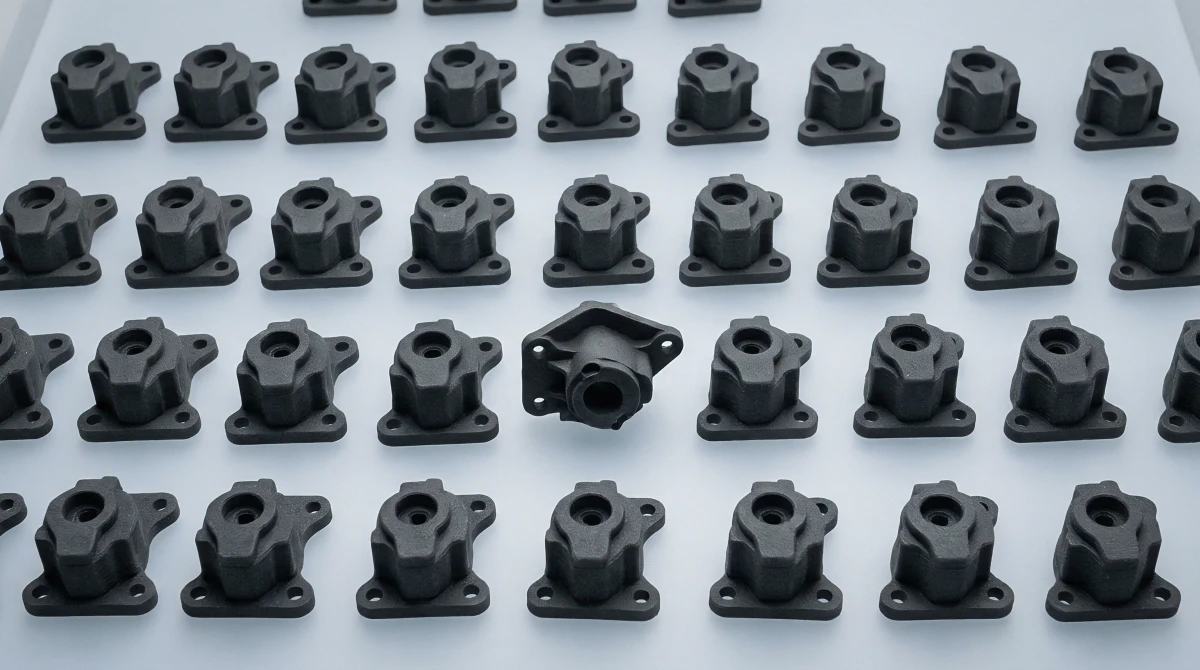
Clause 4.5 divides acceptance into general, qualification parts, the first production part, the final or reference part and the documentation of acceptance. The stages set the order in which a series is released. In a worked case with assumed numbers, 600 parts arrive in 6 lots of 100. Lots 2 to 6 are compared with a reference part kept from lot 1 and with witness specimens from each build. Without a common reference, an assumed drift of 0.1 % per lot compounds to 0.5 % by lot 6. That is the full SLS and MJF band of ±0.5 % used in one direction.Sibling Standards
Four documents of the same family fill what this one leaves open. ISO/ASTM 52900 supplies the vocabulary for naming the process. ISO/ASTM 52921 and ASTM F2971 cover coordinate systems, orientation and the reporting of specimen data. ISO/ASTM 52927 links the characteristics of feedstock and parts to their test methods. An order cites 52901 by edition, ISO/ASTM 52901:2017, and fills the headings of clauses 4.2 to 4.5 with a value or the words “not applicable”. The clause text sits behind the standard’s paywall, so the purchased copy is read before the wording of any clause is relied on.