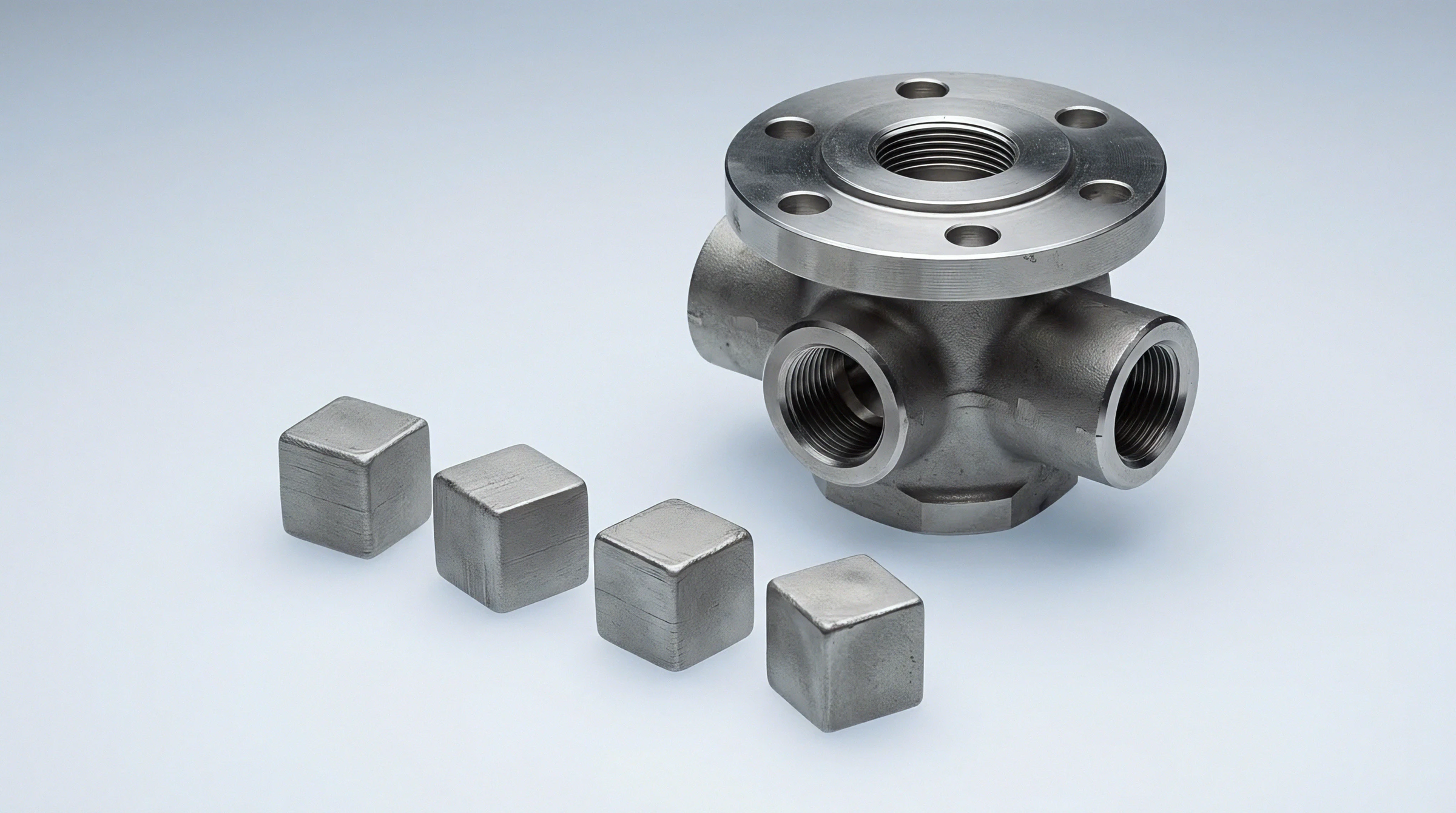
The minimum tensile requirement that ASTM F3184 sets for stress-relieved 316L is 205 MPa (30 ksi) yield and 515 MPa (75 ksi) ultimate, with 30 % elongation, as Carpenter Additive reprints it on its PowderRange 316L datasheet. EOS reports 470 MPa (68.2 ksi) yield for vertical bars of its 316L straight off an EOS M 290, from 189 samples. A part that meets the specification by a margin of more than double on yield still tells the buyer almost nothing about the part. The specification earns its place on a purchase order for other reasons: it fixes the chemistry, names the thermal condition, and lists what the supplier and the buyer agree before the first build.
The sections below read what F3184 covers from its public scope and from open documents that quote it, set its three conditions out as a table, compare its minimums with makers’ measured data, and end with the lines that make it work on an order. ASTM sells the full text; only what its own page and open documents print is used here.
What ASTM F3184 Covers and Who It Binds
ASTM F3184, Standard Specification for Additive Manufacturing Stainless Steel Alloy (UNS S31603) with Powder Bed Fusion, is held by ASTM Committee F42 on additive manufacturing and printed in volume 10.04 of the Annual Book of ASTM Standards. The current edition is F3184-16, reapproved in 2023.
Its scope, as ASTM publishes it, sets six points a buyer can rely on.
- It covers UNS S31603 components made by laser and electron beam full-melt powder bed fusion. UNS S31603 is the low-carbon 316L grade.
- The parts it covers are typically used where mechanical properties similar to machined forgings and wrought products are needed.
- Such parts are often, though not necessarily, post processed by machining, grinding, electrical discharge machining or polishing to reach surface finish and critical dimensions.
- It is written for purchasers, producers, or both, to define requirements and ensure component properties.
- Requirements more stringent than its minimums are added through the purchase order, using supplementary requirements that include S1 to S16.
- Its composition does not meet the requirements for surgical implant grade UNS S31673.
SI units are the standard; other units are for information. The specification covers components, not powder alone, which is why its clauses run from the manufacturing plan through to certification and marking.
F3184 is a component specification. It binds the part and the paperwork around it, and its minimums are the floor the committee agreed, not the properties a modern machine delivers.
Condition A, B and C Thermal States in F3184
The specification sorts parts by thermal condition. A 2018 Electric Power Research Institute presentation on qualifying printed 316L for nuclear pressure-retaining components, hosted by the US Department of Energy, takes F3184-16 as its basis and lists the three conditions and the clauses of the standard.
| Condition | What it is | A cycle of that kind printed on a maker’s sheet |
|---|---|---|
| A | Stress relieved or solution annealed | Colibrium Additive, stress relief per AMS2759/11A at 899 °C (1,650 °F) for 1 h in argon, air cool |
| B | Solution annealed | Carpenter Additive, 1,038 °C (1,900 °F) for 1 h per 76 mm (3 in) of thickness, water quench |
| C | Hot isostatic pressed | Carpenter Additive, per F3184 section 13: at least 100 MPa (14.5 ksi), about 1,141 °C (2,087 °F), 240 min in argon |
Sources: EPRI, Qualification of Laser Powder Bed Fusion-AM for Nuclear Pressure Retaining Applications, slide on F3184-16 requirements; Colibrium Additive, M2 Series 5 Stainless Steel 316L, Thermal States; Carpenter Additive, PowderRange 316L Technical Datasheet, process guidance.
The condition letter is the part of F3184 that travels furthest from the specification into the part. Condition A allows either a stress relief or a solution anneal, which are very different cycles, so “Condition A” on an order still leaves the supplier a choice unless the order closes it.
The cycles in the third column also show how far apart makers’ versions of one condition sit. Carpenter’s sheet describes a stress relief per AMS2759 at 371 °C (700 °F) for 1 hour. Colibrium’s runs at 899 °C. EOS lists a stress relief at 900 °C (1,652 °F) for at least 2 hours with a water quench and a solution anneal at 1,150 °C (2,102 °F) for at least 1.5 hours, also water quenched, and marks heat treatment per AMS 2759 as optional for its own process.
What HIP Does That a Furnace Cycle Does Not
Carpenter recommends HIP as standard practice for homogenizing the microstructure, removing spatter-induced voids, gas porosity carried in from the powder and keyhole porosity, and healing shrinkage micro-cracks, and it follows HIP with a solution anneal to reduce sensitization. A stress relief or anneal changes the metal; only pressure closes the pores.
Minimum Tensile Requirements Against Measured Machine Data
The Condition A minimum is the one row of the specification’s tensile table that an open document prints in full. Carpenter Additive places it under its own measured values, in both the X and Y and the Z directions.
| Source, condition, direction | Yield Rp0.2 | Ultimate | Elongation |
|---|---|---|---|
| F3184-16 Condition A minimum, XY and Z | 205 MPa (30 ksi) | 515 MPa (75 ksi) | 30 % |
| EOS, M 290, 20 µm, as manufactured, vertical | 470 MPa (68.2 ksi) | 540 MPa (78.3 ksi) | 54 % |
| EOS, M 290, 20 µm, as manufactured, horizontal | 530 MPa (76.9 ksi) | 640 MPa (92.8 ksi) | 40 % |
| Colibrium, M2 Series 5, 50 µm, stress relieved, H / V | 405 / 385 MPa (58.7 / 55.8 ksi) | 650 / 600 MPa (94.3 / 87.0 ksi) | 48.0 / 59.5 % |
| Colibrium, solution annealed 1,100 °C (2,012 °F) 4 h, H / V | 250 / 245 MPa (36.3 / 35.5 ksi) | 600 / 575 MPa (87.0 / 83.4 ksi) | 59.5 / 66.5 % |
| Carpenter, HIP and solution anneal, XY / Z | 283 / 283 MPa (41 / 41 ksi) | 641 / 607 MPa (93 / 88 ksi) | 70 / 80 % |
| Nikon SLM, SLM 280, 30 µm, as built, 95/95 minimum, H / V | 545 / 490 MPa (79.0 / 71.1 ksi) | 640 / 580 MPa (92.8 / 84.1 ksi) | 31 / 40 % |
Sources: Carpenter Additive, PowderRange 316L datasheet, room temperature table and footnote 9; EOS, StainlessSteel 316L Material Data Sheet, ISO 6892-1; Colibrium Additive, M2 Series 5 Stainless Steel 316L, tensile tables; Nikon SLM Solutions, 316L Material Data Sheet, argon, machined specimens. Carpenter also gives a reduction of area minimum of 40 % in the F3184 row.
Every row clears the minimum, and the most heavily treated rows clear it by the least. The Colibrium solution-annealed bars at 1,100 °C keep 245 MPa yield in the vertical direction, 40 MPa above the floor; the as-built Nikon minimum sits more than 280 MPa above it. A specification minimum at wrought-annealed levels is easy to meet in any condition, and Colibrium states that all its parameters exceed the F3184 minimums in the stress-relieved state.
The Nikon rows deserve a second look because of how they are stated. Nikon SLM prints a mean and a minimum, and defines the minimum as 95 % population coverage at 95 % confidence. That is a statistical statement about the material, which the bare F3184 minimum is not. A buyer who needs to know how low a part from the next lot can go is better served by a figure of that kind than by the specification row.
The F3184 tensile minimum separates 316L from a failed build. It does not separate one supplier’s parameters, condition or machine from another’s.
Chemistry Limits for UNS S31603 in F3184
Nikon SLM Solutions prints the F3184 composition beside two wrought specifications on its 316L sheet, which is the clearest open source for the chemistry limits.
| Element | ASTM F3184 | ASTM A276 | DIN EN 10088, 1.4404 | EOS 316L powder, per ASTM F138 |
|---|---|---|---|---|
| Chromium | 16.00 to 18.00 | 16.00 to 18.00 | 16.5 to 18.5 | 17.00 to 19.00 |
| Nickel | 10.00 to 14.00 | 10.00 to 14.00 | 10.0 to 13.0 | 13.00 to 15.00 |
| Molybdenum | 2.00 to 3.00 | 2.00 to 3.00 | 2.00 to 2.50 | 2.25 to 3.00 |
| Manganese, max | 2.00 | 2.00 | 2.00 | Not listed |
| Silicon, max | 1.00 | 1.00 | 1.00 | Not listed |
| Carbon, max | 0.030 | 0.030 | 0.030 | 0.03 |
| Nitrogen, max | Not listed | Not listed | 0.10 | 0.10 |
| Phosphorus and sulfur, max | 0.045 and 0.030 | 0.045 and 0.030 | 0.045 and 0.030 | Not listed |
Sources: Nikon SLM Solutions, 316L Material Data Sheet, chemical composition tables; EOS, StainlessSteel 316L Material Data Sheet, powder chemical composition.
The F3184 and A276 columns match, which is the point of the specification for a buyer replacing a bar-stock part: the printed alloy is the same 316L on paper. More instructive is the EOS column. EOS states that its powder corresponds to ASTM F138, the surgical implant standard for UNS S31673, and its chromium range runs to 19.00 % and its nickel range to 15.00 %, both above the F3184 ceilings of 18.00 and 14.00 %. A lot of that powder near the top of its own range would sit outside F3184, while a lot near the middle would sit inside both.
Carpenter’s PowderRange 316L, by contrast, lists F3184 as its applicable specification and a type analysis of 16.0 to 18.0 % chromium, 10.0 to 14.0 % nickel and 2.00 to 3.00 % molybdenum, matching F3184, with oxygen at 0.10 % maximum. Colibrium states that its powder chemistry follows F3184 UNS S31603 and ASTM A276.
The order therefore needs the lot certificate of the powder, checked against the F3184 column, and not only the powder’s trade name.
What the Supplier and the Purchaser Agree
The EPRI slide lists the clauses of F3184-16 and marks those whose content is agreed between the component supplier and the purchaser. That marking is the most useful thing a buyer can learn about the specification, because it shows where F3184 sets a requirement and where it only sets a heading.
- Ordering information, the manufacturing plan, feedstock, chemical requirements, thermal processing for Conditions A, B and C, certification and product marking, and quality program requirements are listed as clauses of the standard.
- Processing, microstructure, mechanical properties, hot isostatic pressing, dimensions and permissible variations, and inspection are marked as agreed between supplier and purchaser.
Read with the scope, this says F3184 hands the buyer the structure of an agreement and leaves the substance of six clauses to the order. The tensile values above the minimum, the HIP cycle, the dimensional tolerances and the inspection method are written by the parties, and the supplementary requirements S1 to S16 are where many of them are picked from.
The same presentation shows what a demanding buyer added on top. For each component in its program it called for parameter data sheets for every build, drawings, geometric inspection of the final part, chemical analysis of powder and part, HIP and solution anneal parameters, digital radiography or ultrasonic inspection, grain size, density and inclusion content, tensile tests to 427 °C (800 °F) and room-temperature tensile tests on three vertical build control samples. None of that appears in the specification as a fixed requirement; all of it fits under its agreed clauses.
Anisotropy, Porosity and Machine Variation Left Open
Three questions decide how a printed 316L part behaves in service and are not settled by the minimums in F3184.
Direction of Loading
A US Bureau of Reclamation study printed a 127 mm (5 in) open cube in 316L on an SLM 280HL, from recycled 15 to 45 µm powder at 50 µm layers, 3,082 layers in 75 hours, and tested it as built. Average yield across all printed samples was 74,800 psi (516 MPa), above the 49,000 psi (338 MPa) of the wrought plate tested alongside. Samples pulled across the layers had the lowest yield and a notably lower ultimate strength, closer to but below the wrought samples, which the report attributes to interlayer bonding. Its conclusion asks for build orientation to be considered and for suitability to be assessed case by case.
Porosity
The same cube measured 96 to 97 % dense for all but one sample. EOS reports an average defect percentage of 0.018 % and a density of at least 7.97 g/cm³ (0.288 lb/in³) to ISO 3369 over 45 samples for its own process. Both are printed 316L; the difference is the process. A study from Georgia Tech and Sandia National Laboratories found nearly 50,000 pores across 75 tensile samples and identified pores above 125 µm (0.005 in) in diameter as the threshold that best predicted the loss of ductility.
The Machine Behind the Part
An Oak Ridge National Laboratory report on printed 316H, the high-carbon sister grade, built coupons on a GE Concept Laser M2, a Renishaw AM400 and an EOS M290. It found that differences between systems and powder batches are starkest as printed and that heat treatment and HIP reduce the scatter, with stress relief and solution annealing reducing directional anisotropy. Similarly heat-treated samples showed similar tensile strength regardless of system.
Two parts can both meet F3184 and still differ in direction, density and the machine that made them. The order closes those gaps; the specification only names where they are.
Writing F3184 Into a Purchase Order
The open documents point to a short list of lines that turn F3184 from a heading into a requirement.
- Cite F3184-16 (reapproved 2023) and the condition letter, and then the actual cycle: temperature, time, atmosphere and cooling for stress relief or anneal, and pressure, temperature and time for HIP.
- Ask for the powder lot certificate and check it against the F3184 chemistry, not the powder’s own house range.
- Write tensile requirements above the minimum where the design needs them, in the direction of loading, with the test standard and the specimen type.
- Ask for build control or witness specimens from the same build, in the direction that matters.
- State density or porosity limits and the inspection method, such as computed tomography or radiography, where internal defects matter.
- Choose from the supplementary requirements S1 to S16 what the part needs and name them.
- Ask for the parameter set and machine to be recorded per build, so that a later lot can be traced to the same process.
For a buyer moving a 316L part from bar stock to low-volume 3D printing for bridge production, F3184 supplies the common language, and the order supplies the numbers that make two suppliers’ parts comparable.
Sources and Further Reading
- ASTM F3184-16(2023), Standard Specification for Additive Manufacturing Stainless Steel Alloy (UNS S31603) with Powder Bed Fusion, abstract and scope, ASTM International
- Qualification of Laser Powder Bed Fusion-AM for Nuclear Pressure Retaining Applications, 2018, Electric Power Research Institute via US Department of Energy
- PowderRange 316L Technical Datasheet, 13 March 2025, Carpenter Additive
- EOS StainlessSteel 316L Material Data Sheet, EOS M 290, 20 µm, EOS
- L-PBF Stainless Steel 316L Parameters for M2 Series 5, Rev A, 2024, Colibrium Additive
- 316L Material Data Sheet, ASTM A276, DIN EN 10088, 1.4404, ASTM F3184, 2026-01, Nikon SLM Solutions
- Analysis of 316L Stainless Steel Powder Bed Fusion Material, ST-2021-19085-3, US Bureau of Reclamation
- Effects of Spatial Energy Distribution-Induced Porosity on Mechanical Properties of Laser Powder Bed Fusion 316L Stainless Steel, Georgia Institute of Technology and Sandia National Laboratories via NSF PAR
- Report on Updated Properties Handbook of Printed Stainless Steel 316, ORNL/TM-2025/4107, August 2025, Oak Ridge National Laboratory via OSTI