Parameter Set

A parameter set is a machine maker's named, validated recipe of process settings for one material, machine and layer thickness.

Every Parameter Set article of the 3D Printing Resources, newest first, each written from published standards, research and makers’ data.

Meaning

A parameter set is a machine maker’s named, validated recipe of process settings for one material, machine and layer thickness. Datasheet figures belong to a parameter set, not to the material in general. EOS names its 316L sets, such as 316L_Surface and 316L_040_FlexM291, and publishes figures for each. It publishes its PA 2200 data for the Balance set at 120 µm (0.0047 in) layers.

Fixed Settings

An EOS process sheet lists the system, the software version, the recoater blade, the nozzle, the inert gas and the sieve. It then gives the layer thickness, the minimum wall, the dimensional change after heat treatment and the volume rate. The 20 µm set lists a 0.3 to 0.4 mm (0.012 to 0.016 in) minimum wall and +0.02 %. The 40 µm set lists 0.1 mm (0.004 in) and +0.2 %.
Read More

Readiness Level

EOS assigns each set a technology readiness level. The 20 µm set is validated to level 9 and the 40 µm sets to level 7. The Core 40/80 µm set is rated level 3. A drawing that names a level 3 set asks for the least validated of the four. The Core set reports typical figures with no sample count.

Hidden Settings

Much of what a set controls never appears on a drawing. In a 316L thin-wall study, the contour scan and its inward offset changed the wall error by roughly 40 to 45 %. The paper estimates a final gap as the nominal gap minus the offset minus the melt pool width. A buyer cannot see those settings, so the order names the set that holds them.

Set Naming

An order names the powder, the machine, the layer thickness and the set by its maker’s name. A later change of set then counts as a change to the order under ISO/ASTM 52901, clause 4.3.9. For nylon, the named recipe plays the same role, since a datasheet holds true only for the recipe it names.
3D Printing Defects in a Production Batch Traced to Their Cause

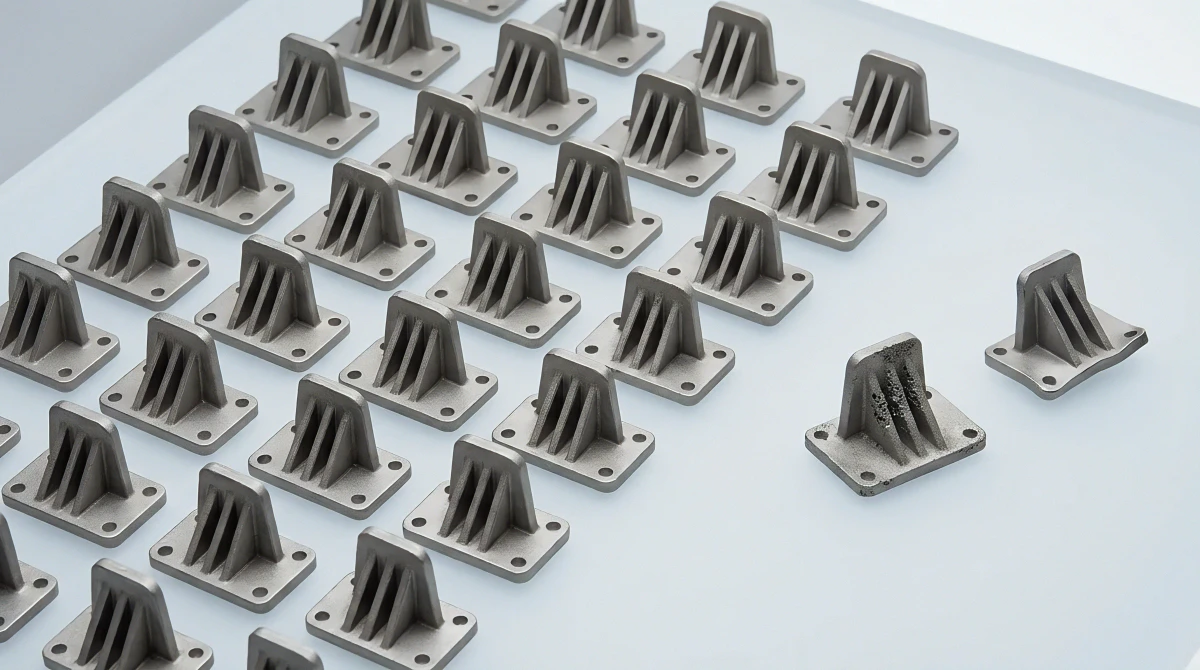
A defect in a printed batch is traced by its pattern, every part, one zone, one build or a slow trend across builds, and each pattern points to its own cause and evidence.

Reading a Defect by Its Pattern Across the BatchThe 2022 review sorts the sources of metal powder bed defects into three groups: defects transferred from the feedstock powder, defects formed in the interaction of the beam with powder and metal during melting, and defects created in post-processing such as heat treatment. It adds a fourth set of contributors around them: the equipment, powder handling and dispensing, and build preparation, meaning orientation and supports.

Surface Roughness of 3D Printed Parts by Process and Orientation

Process sets the floor of roughness and orientation moves it face by face, so a printed part's roughness note names the parameter, the face, its build direction and the finish.

Typical Ra and Sa of SLA, SLS, MJF and Metal SurfacesA review of as-printed polymer roughness in the International Journal of Advanced Manufacturing Technology collects dozens of studies by process. Another study printed one test artifact on four processes and measured them all the same way.

ASTM F3184 Specification for Powder Bed Fusion 316L Stainless Steel

ASTM F3184 fixes the chemistry, the thermal condition and the headings of a 316L order, and leaves the real property, density and inspection requirements for the buyer to write.

What ASTM F3184 Covers and Who It BindsASTM F3184, Standard Specification for Additive Manufacturing Stainless Steel Alloy (UNS S31603) with Powder Bed Fusion, is held by ASTM Committee F42 on additive manufacturing and printed in volume 10.04 of the Annual Book of ASTM Standards. The current edition is F3184-16, reapproved in 2023.

TPU Flexible Powder for SLS and MJF Parts

TPU from a powder bed is equally soft in every direction but stretches far less across its layers, so grade, machine, build direction and test method all belong in the order.

TPU Powder Grades and Their Tensile Properties in XY and ZFour makers' sheets give enough to compare. Forward AM, the additive business of BASF, publishes four Ultrasint TPU powders side by side in one brochure, which makes it the cleanest set: the same company, the same tests, four grades.

AlSi10Mg Aluminum Properties in Laser Powder Bed Fusion

Printed AlSi10Mg is stronger than the cast alloy as built, and the heat treatment named on the order decides how much strength is traded for ductility or conductivity.

AlSi10Mg Tensile and Yield Strength by Heat TreatmentThe first answer a buyer needs is the strength in each state the material is delivered in. Two makers publish it for their own systems and parameters, and their numbers are close enough to read together and different enough to show why the state and the source both travel with a figure.

316L Thin Wall and Gap Dimensional Error in Laser Powder Bed Fusion

Printed metal walls and gaps land off the drawing by an amount the laser settings control, so a requirement names the parameter set, the gap needed and the finished size.

Thin Wall and Gap Error in 316L Laser Powder Bed FusionThe machine maker states accuracy as a band. EOS's sheet for 316L, dated May 2014, gives a typical achievable part accuracy of about ±20 to 50 µm (±0.0008 to 0.002 in) for small parts and about 0.2 % for large parts, and a minimum wall thickness of about 0.3 to 0.4 mm (0.012 to 0.016 in).

ISO/ASTM 52901 Requirements for Purchased Additive Manufactured Parts

The purchased parts standard lists what an additive parts order carries, from tolerances and feedstock to three acceptance stages, and leaves every value to the buyer.

What ISO/ASTM 52901 Asks a Buyer and a Supplier to ExchangeThe scope has three sentences and each one shapes how the standard is used. The first says the document defines and specifies requirements for purchased parts made by additive manufacturing.

316L Stainless Steel Properties in Laser Powder Bed Fusion

Printed stainless steel is stronger along the layers and more ductile across them, and its size and finish depend on the parameter set and the heat treatment you name.

What 316L Is in a Laser Powder Bed Machine316L is a molybdenum-alloyed austenitic stainless steel. EOS markets its powder as a marine-grade steel with enhanced corrosion resistance in chloride environments, and it lists high ductility, high strength and high corrosion resistance as the main characteristics.

Send the 3D File of Your Printed Part

Send the 2D drawing and the 3D file, with the quantity and the stage of the project. An engineer replies within 1 working day.

The quote form, the mutual NDA and the private folder for your files are on Protolis Atelier, with 3D Printing chosen.

Request a Quote