ISO/ASTM 52900

ISO/ASTM 52900 is the vocabulary standard of additive manufacturing, fixing the terms and the 7 process categories an order is written in.

Every ISO/ASTM 52900 article of the 3D Printing Resources, newest first, each written from published standards, research and makers’ data.

Meaning

ISO/ASTM 52900 is the vocabulary standard of additive manufacturing, fixing the terms and the 7 process categories an order is written in. Its second edition, of November 2021, was prepared by ISO/TC 261 with ASTM F42 and CEN/TC 438. It sets no tolerance, names no material and gives no pass mark. It lists no normative references, so it stands on its own.

Categories

The 7 categories are material extrusion, material jetting, binder jetting, sheet lamination, vat photopolymerization, powder bed fusion and directed energy deposition. Only material extrusion and powder bed fusion receive their own clauses for processing terms, 3.7 and 3.8. Not every process fits one category, and hybrid processes fit none. A supplier with a hybrid process is asked for its sequence of operations.
Read More

Layout

Clauses 3.1 to 3.12 run from general terms and categories through processing, data, positioning, material, parts and evaluation. Clause 3.5 holds the vocabulary for positioning, coordinates and orientation. Annex A, normative and new in this edition, identifies processes by category and determining characteristics. Annex B, informative, covers basic principles.

Editions

The second edition replaced ISO/ASTM 52900:2015. CEN adopted it as EN ISO/ASTM 52900:2021 in December 2021, and Germany published it as DIN EN ISO/ASTM 52900:2022-03. An order that says “ISO/ASTM 52900:2021” is clear everywhere. One that says only “ISO 52900” could point to the 2015 edition.

Order Wording

An order names the process by category and brand in one line, such as powder bed fusion (SLS) per ISO/ASTM 52900:2021. ISO/ASTM 52901 then lists what the order contains, and the vocabulary keeps every later document’s words fixed.
How Many Parts Fit in One SLS or MJF Build

Chamber volume times packing density divided by part volume sets the count, and every term has a published limit.

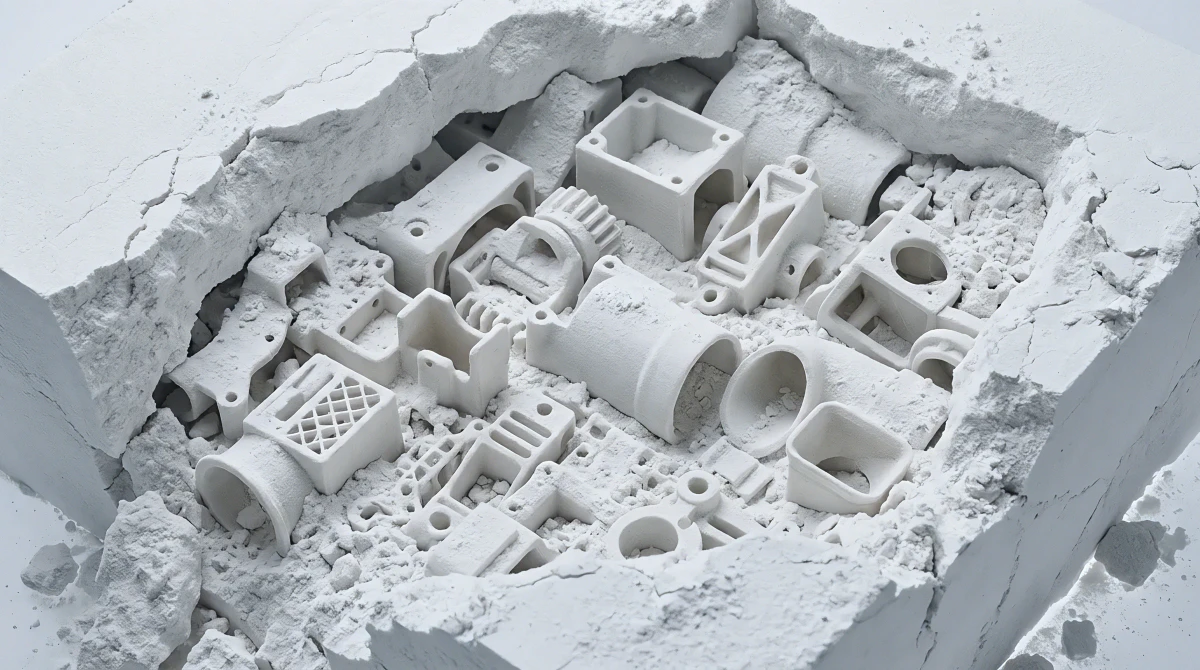
How Many Parts Fit in a Powder Bed Fusion BuildPowder bed fusion, one of the seven process categories in ISO/ASTM 52900, builds parts inside a bed of powder that supports them, so a chamber can be filled in three dimensions and the parts need no support structures. The count that results is set by three quantities: the usable volume, the share of that volume that holds parts, and the volume of the part itself.

ISO/ASTM 52901 Requirements for Purchased Additive Manufactured Parts

The purchased parts standard lists what an additive parts order carries, from tolerances and feedstock to three acceptance stages, and leaves every value to the buyer.

What ISO/ASTM 52901 Asks a Buyer and a Supplier to ExchangeThe scope has three sentences and each one shapes how the standard is used. The first says the document defines and specifies requirements for purchased parts made by additive manufacturing.

ISO/ASTM 52900 Additive Manufacturing Terms and the Seven Process Categories

The vocabulary standard fixes the words an additive order is written in, so name the process category beside the brand and let other standards set quality.

What ISO/ASTM 52900 Covers and What It Leaves OutISO/ASTM 52900 establishes and defines the terms used in additive manufacturing (AM), the technology that applies an additive shaping principle and builds physical three-dimensional geometries by successive addition of material. Its scope sentence also states that the terms are classified into specific fields of application.

Send the 3D File of Your Printed Part

Send the 2D drawing and the 3D file, with the quantity and the stage of the project. An engineer replies within 1 working day.

The quote form, the mutual NDA and the private folder for your files are on Protolis Atelier, with 3D Printing chosen.

Request a Quote