Meaning
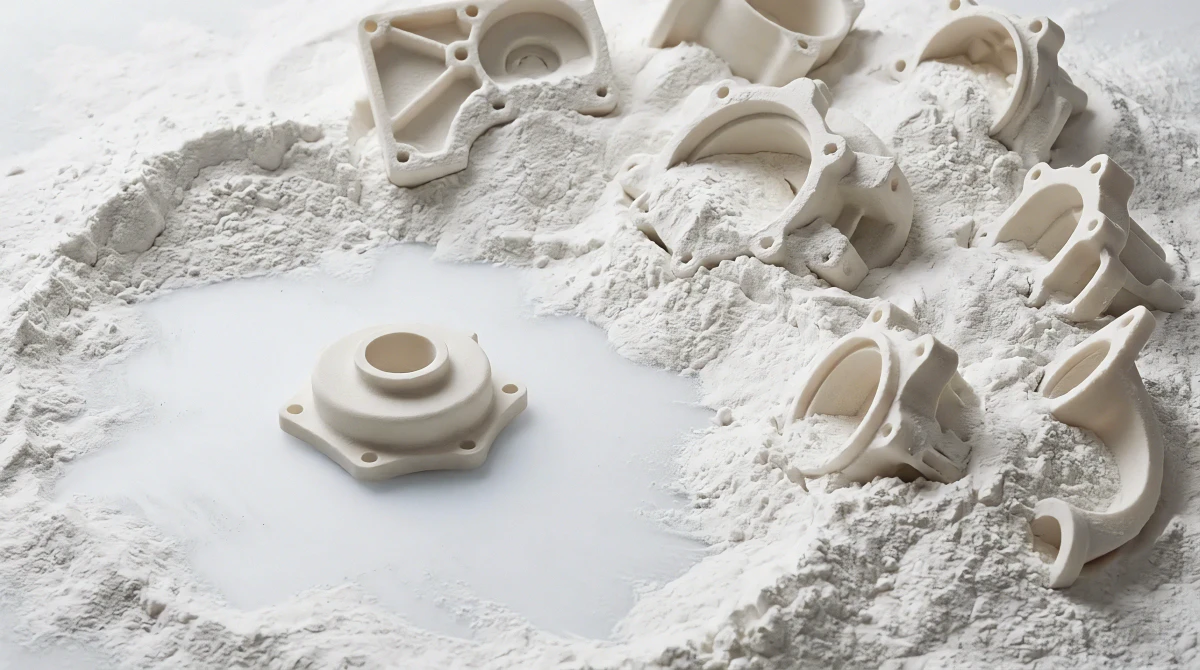
Feedstock is the raw material a printer consumes to build a part, such as metal powder, polymer powder or liquid resin. ISO/ASTM 52900 holds the feedstock terms among its words for material. ISO/ASTM 52901 gives feedstock for the part its own clause in an order, 4.3.6. ISO/ASTM 52927 makes testing the feedstock one of its three layers of testing, beside process monitoring and part testing.Powder Records
EOS prints a composition range for its 316L powder and a particle size distribution of 20 to 65 µm (0.0008 to 0.0026 in). Its process line calls for a 63 µm (0.0025 in) sieve. HP prints melting point, particle size and bulk density for its PA 12 grades. High Reusability PA 12 has a 60 µm (0.0024 in) particle and a bulk density of 0.425 g/cm³ (0.0154 lb/in³). The glass bead grade has 58 µm (0.0023 in) and 0.48 g/cm³ (0.0173 lb/in³).Read More
Reuse and Aging
Unfused powder is sieved and used again, and it ages in the printer. HP states stable performance for High Reusability PA 12 at a 20 % refresh rate. It asks at least 30 % for the glass bead grade. Formlabs lists 30 % for nylon 12 on the Fuse X1. HP’s glass bead sheet tests powder aged in real printing conditions by generation and calls that the worst case. The refresh ratio sets how much fresh powder each build needs.Liquid Feedstock
Resin is a liquid feedstock that a light source cures into thin solid layers. Its liquid rows tell the operator how it cures. Somos EvoLVe 128, for one, has a viscosity of about 380 cps at 30 °C (86 °F). The wash bath then carries resin from part to part and ages like powder does.Feedstock Clause
An order names the powder or resin grade under clause 4.3.6, with the refresh or lot rule where the maker gives one. It asks for the feedstock record as a deliverable beside the process records and the part tests. Feedstock records say what went into a build. With them, a buyer can compare lots even where a part cannot be tested without destroying it.