ISO 527

ISO 527 is the ISO tensile test for plastics, cited by EOS in its parts 1 and 2 for the PA 2200 tensile rows.

Every ISO 527 article of the 3D Printing Resources, newest first, each written from published standards, research and makers’ data.

Meaning

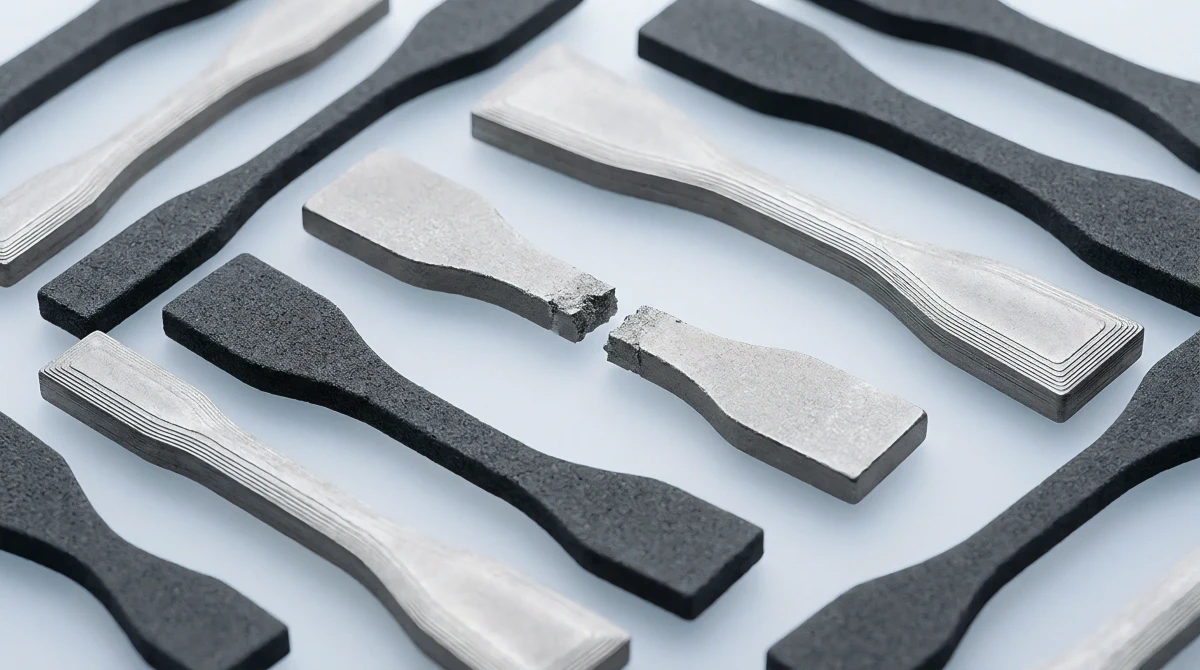
ISO 527 is the ISO tensile test for plastics, cited by EOS in its parts 1 and 2 for the PA 2200 tensile rows. It is the counterpart of ASTM D638, which HP uses on type V specimens. The two procedures differ in specimen size and test speed. A strength compared across them compares procedures as well as powders.

PA 2200 Values

Under ISO 527, PA 2200 gives a tensile modulus of 1,650 MPa (239 ksi) in X, Y and Z. Its tensile strength is 48 MPa (6,960 psi) in X and Y and 42 MPa (6,090 psi) in Z. Its elongation at break is 18 % in X and Y and 4 % in Z. Those are typical values for the Balance set at 120 µm.
Read More

ISO Method Family

EOS quotes the ISO family through its sheets. Flexure follows ISO 178, impact ISO 179 and ISO 180, and heat deflection ISO 75. Melting follows ISO 11357 and hardness ISO 7619-1. A sheet rarely mixes the ISO and ASTM families, so a buyer comparing makers often holds figures from two different methods.

Strain Definitions

An EOS footnote states that its strain column holds strain at break for brittle behavior and nominal strain at break for ductile behavior. The same column can therefore hold two quantities between materials, and between directions of one material.

Witness Testing

An order asks for witness specimens from the same build, tested per ISO 527 or ASTM D638, in a stated orientation. It writes the method with its edition, as ISO/ASTM 52927 recommends for a test and supply agreement.
TPU Flexible Powder for SLS and MJF Parts

TPU from a powder bed is equally soft in every direction but stretches far less across its layers, so grade, machine, build direction and test method all belong in the order.

TPU Powder Grades and Their Tensile Properties in XY and ZFour makers' sheets give enough to compare. Forward AM, the additive business of BASF, publishes four Ultrasint TPU powders side by side in one brochure, which makes it the cleanest set: the same company, the same tests, four grades.

ISO/ASTM 52927 Main Characteristics and Test Methods for AM Parts

The test methods standard links the characteristics of additive feedstock and parts to test procedures, and a buyer fixes the method, specimen, orientation and statistical basis in the order.

What ISO/ASTM 52927 Covers and Who It Is ForThe scope states that the document specifies the principal requirements applied to the testing of parts produced by additive manufacturing processes. It does three things.

ISO/ASTM 52901 Requirements for Purchased Additive Manufactured Parts

The purchased parts standard lists what an additive parts order carries, from tolerances and feedstock to three acceptance stages, and leaves every value to the buyer.

What ISO/ASTM 52901 Asks a Buyer and a Supplier to ExchangeThe scope has three sentences and each one shapes how the standard is used. The first says the document defines and specifies requirements for purchased parts made by additive manufacturing.

PA12 Nylon Properties for SLS and MJF Parts

Powder-bed nylon parts stretch far less along the build axis than in the layer plane, so a drawing needs a build direction, a grade and the test method.

What PA12 Powder Gives a Printed PartPolyamide 12 is the base polymer of the most common powders for laser sintering and for HP Multi Jet Fusion. EOS describes PA 2200, its PA12 powder, as a balanced property profile and "the most proven material on the market" for its machines.

Send the 3D File of Your Printed Part

Send the 2D drawing and the 3D file, with the quantity and the stage of the project. An engineer replies within 1 working day.

The quote form, the mutual NDA and the private folder for your files are on Protolis Atelier, with 3D Printing chosen.

Request a Quote