Meaning
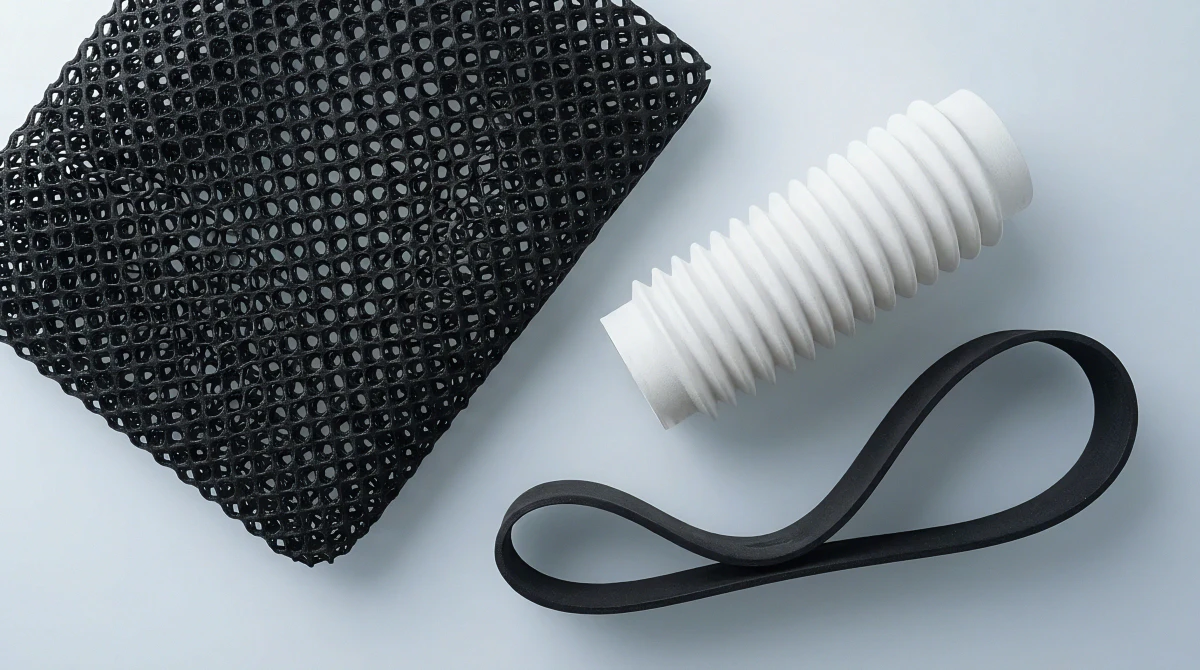
TPU, thermoplastic polyurethane, is the flexible, rubber-like powder of laser sintering and HP Multi Jet Fusion, used for parts around 86 to 90 Shore A. Its makers list gaskets, seals, grips, bellows, insoles, pads, protective equipment and elastic lattices among its uses.Grades
BASF Forward AM publishes four Ultrasint TPU powders side by side: TPU01 for HP’s 5200 series at 88 to 90 Shore A, 9 MPa (1,305 psi) tensile in XY and 7 MPa in Z, 280 % elongation in XY and 150 % in Z; TPU 88A; TPU 88A Black, which stretches 360 % in XY and 100 % in Z; and TPU 90A LT. Raise3D gives 11.2 MPa and 248.3 % for its TPU 90A Black in the X direction only, and Sinterit gives 5.0 MPa and 100 % for Flexa Performance on its Lisa printers.Read More
Direction
Hardness is the same in every direction, but elongation in Z is between a little over a quarter and a little over half of elongation in XY on the grades that report both. A strap, hinge or bellows that flexes across the layers sees the lower figure, so build direction belongs on the drawing.Test Method
The sheets use different standards for the same word: DIN 53504 and ISO 37, which are rubber methods, ISO 527-2 for plastics, and DIN ISO 7619-1 or ISO 868 for hardness. Grades compare cleanly only inside one maker’s table.Reuse and Finish
Forward AM lists an 80/20 used to new refresh rate for its TPU line, against 50/50 for PA11, and Sinterit notes that Flexa may need an extra 50 % refresh when surface quality drops. DyeMansion’s shot surfacing does not suit TPU, but vapor smoothing does: a sintered TPU went from Ra 18.9 µm (744 µin) to 3.34 µm (131 µin).