Critical Exposure

Critical exposure is the light energy per area at which a stereolithography resin starts to cure, printed on resin datasheets in mJ/cm².

Every Critical Exposure article of the 3D Printing Resources, newest first, each written from published standards, research and makers’ data.

Meaning

Critical exposure is the light energy per area at which a stereolithography resin starts to cure, printed on resin datasheets in mJ/cm². Datasheets give it beside penetration depth, the depth to which the light reaches into the resin. Together the two tell a printer how much energy cures a layer of a given thickness. They describe the liquid, not the cured part.

Exposure Values

Somos EvoLVe 128 gives a critical exposure of 9.3 mJ/cm² and a penetration depth of 0.11 mm (4.3 mils). Its sheet adds an exposure of 95.1 mJ/cm² for a layer 0.254 mm (0.010 in) thick. Accura 25 gives 10.5 mJ/cm² and about 0.11 mm (4.2 mils). Accura Xtreme gives 11.7 mJ/cm² and about 0.10 mm (4.1 mils).
Read More

Build Time

A machine with a known laser power could derive an exposure time from these values. The EvoLVe datasheet does not do so, and the sources give no time per layer for resin. The print time of a resin batch is therefore set by layer count and exposure, without a published figure to quote.

Green State

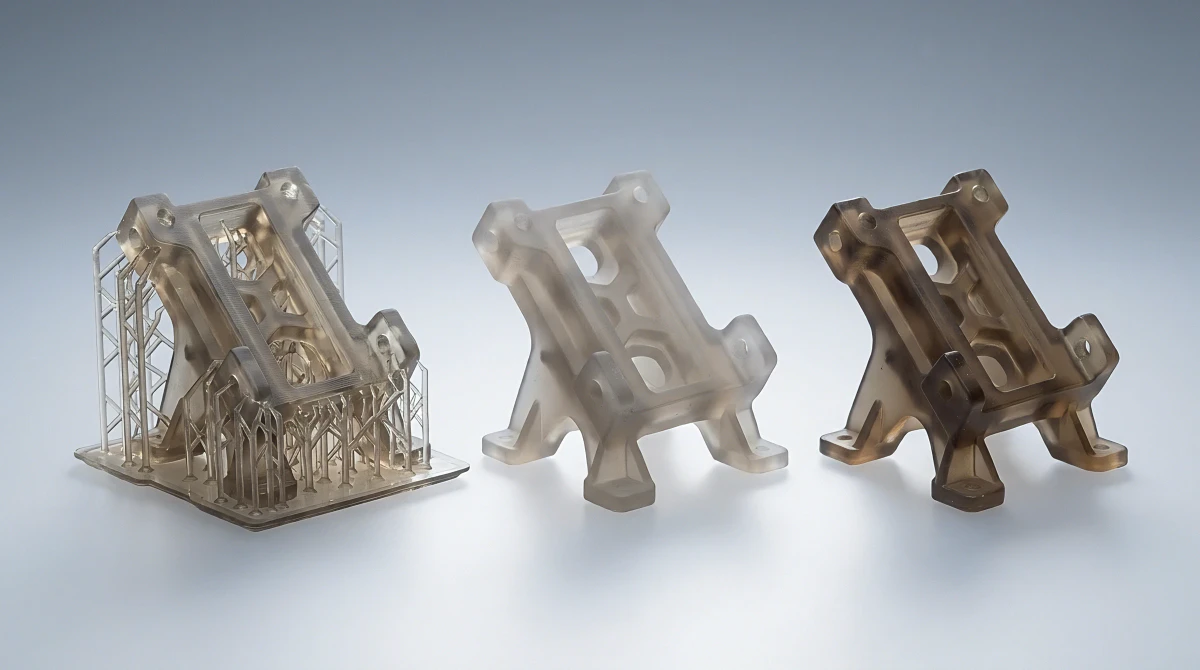
A resin printer exposes each layer for long enough to hold it to the layer below. The part leaves the printer in a green state, with its reaction unfinished. The post-cure completes the conversion through the whole part, and the property tables are headed with that cure condition.

Buyer Relevance

No row of the cured property table depends on critical exposure alone. A buyer has little use for it beyond knowing that the printer’s exposure is set to the resin. The order names the resin, the printer family and the post-cure, which fix the properties the part delivers.
How Long a Batch of 3D Printed Parts Takes From Print to Pack-Out

A printed batch runs on four clocks, build, cooldown, finishing and inspection, and a stated lead time should show each.

Lead Time for a 3D Printed Batch Stage by StageThe calendar of a batch has the same skeleton in every process. Files are prepared and nested, the machine builds, the work cools or cures, parts are separated from what held them, and finishing and inspection follow.

SLA Wash and Post-Cure Step by Step From Green Part to Finished Resin Part

Wash each resin for its own time, dry it fully, cure to the datasheet condition, then remove supports and measure.

SLA Wash, Dry, Cure and Support Removal in OrderThe part leaves the printer in a green state: polymerized enough to keep its shape, but with its reaction unfinished and a film of liquid resin over it. The order in which the finishing steps run is set by what each one needs from the one before.

Tough SLA Resins as Stand-Ins for ABS and Polypropylene

Tough SLA resins match ABS on stiffness and strength but not on fracture energy or heat, so a part needs the row that governs its duty.

What a Tough SLA Resin Is Meant to ReplaceA tough SLA resin is a photopolymer that cures under ultraviolet light into a solid that bends before it breaks. Its makers aim it at the parts where earlier SLA resins cracked: snap fits, hinges, housings that are dropped and jigs that get clamped.

Send the 3D File of Your Printed Part

Send the 2D drawing and the 3D file, with the quantity and the stage of the project. An engineer replies within 1 working day.

The quote form, the mutual NDA and the private folder for your files are on Protolis Atelier, with 3D Printing chosen.

Request a Quote