Laser Power

Laser power is the output of the laser that melts or sinters each layer, stated in watts and set in the machine's parameters.

Every Laser Power article of the 3D Printing Resources, newest first, each written from published standards, research and makers’ data.

Meaning

Laser power is the output of the laser that melts or sinters each layer, stated in watts and set in the machine’s parameters. It sets the size of the melt pool and so how far a printed feature grows beyond its drawn size. Machines record it during the build as part of process monitoring. It is a setting the supplier holds in its parameter set, not a figure on a drawing.

Machines

The EOS M 290 carries a 400 W ytterbium fiber laser. The Formlabs Fuse 1+ 30W sinters nylon with 30 W and the Fuse X1 with 120 W. A 316L research study used an Aconity MIDI with a single-mode fiber laser of up to 1,000 W.
Read More

Effect on Size

The study printed 316L walls at 260, 440 and 620 W, at a fixed scan speed of 1,466.6 mm/s (57.7 in/s). From 260 to 620 W the melt pool area grew 2.5 times, from 3,842 to 9,662 µm². Walls drawn 0.20 mm (0.008 in) thick grew from 0.304 to 0.423 mm (0.012 to 0.017 in). Gaps of 0.20 mm closed completely at the higher powers. Analysis of variance found laser power significant on the error, p below 0.0001.

Effect on Surface

Vertical wall roughness rose with power, from Ra 13.94 to 21.35 µm (549 to 841 µin). At the highest power the melt pool migrated toward the powder and formed dross, protrusions outside the intended geometry. A contour scan with an inward offset cut the wall error by roughly 40 to 45 %.

Monitoring

The EOS M 290 brochure lists laser power among the values monitored continuously, and laser power measured throughout the build. ISO/ASTM 52927 treats such process monitoring as one of its 3 layers of testing. An order names the parameter set that fixes the power and asks for the printed result on a sectioned witness feature.
3D Printing Defects in a Production Batch Traced to Their Cause

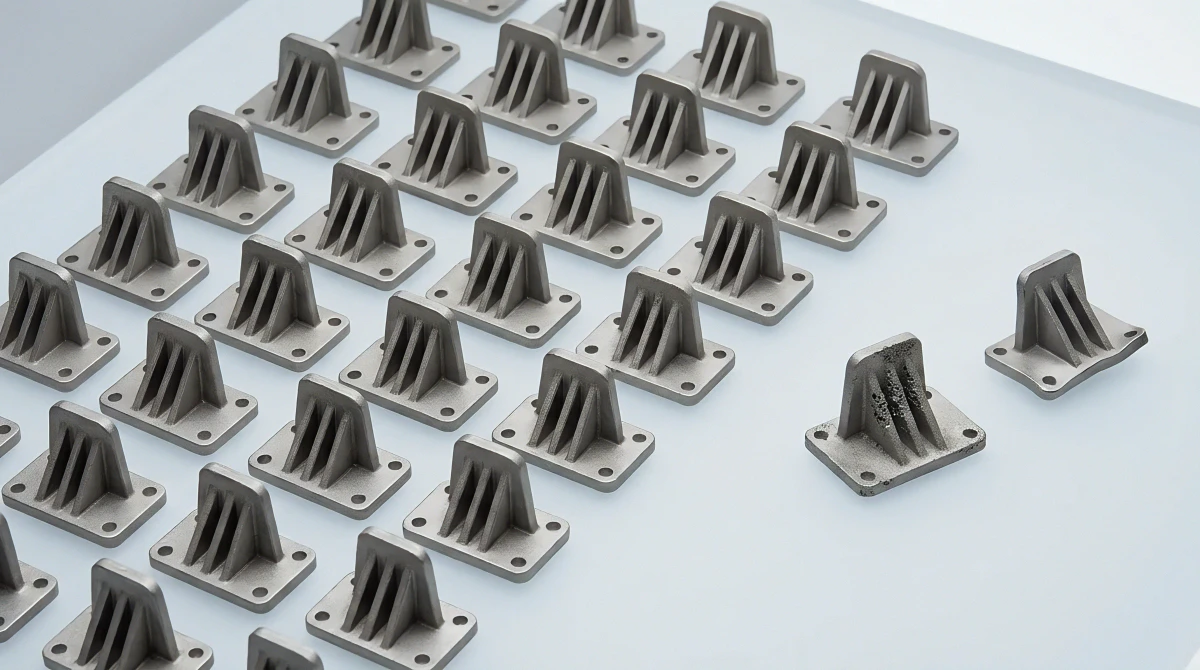
A defect in a printed batch is traced by its pattern, every part, one zone, one build or a slow trend across builds, and each pattern points to its own cause and evidence.

Reading a Defect by Its Pattern Across the BatchThe 2022 review sorts the sources of metal powder bed defects into three groups: defects transferred from the feedstock powder, defects formed in the interaction of the beam with powder and metal during melting, and defects created in post-processing such as heat treatment. It adds a fourth set of contributors around them: the equipment, powder handling and dispensing, and build preparation, meaning orientation and supports.

Surface Roughness of 3D Printed Parts by Process and Orientation

Process sets the floor of roughness and orientation moves it face by face, so a printed part's roughness note names the parameter, the face, its build direction and the finish.

Typical Ra and Sa of SLA, SLS, MJF and Metal SurfacesA review of as-printed polymer roughness in the International Journal of Advanced Manufacturing Technology collects dozens of studies by process. Another study printed one test artifact on four processes and measured them all the same way.

Clearance for Snug and Sliding Fits Between 3D Printed Parts

Printed fits start from a published gap that depends on whether parts are built apart or together, lose clearance to undersized bores, and are settled by a fit coupon.

Starting Clearances for Snug and Sliding Fits in SLS and MJFA snug fit here means two printed parts that assemble with little play and stay together; a sliding fit means two parts that move against each other after assembly. The published values separate them by how the parts were made, more than by how tight the fit is meant to be.

AlSi10Mg Aluminum Properties in Laser Powder Bed Fusion

Printed AlSi10Mg is stronger than the cast alloy as built, and the heat treatment named on the order decides how much strength is traded for ductility or conductivity.

AlSi10Mg Tensile and Yield Strength by Heat TreatmentThe first answer a buyer needs is the strength in each state the material is delivered in. Two makers publish it for their own systems and parameters, and their numbers are close enough to read together and different enough to show why the state and the source both travel with a figure.

Metal 3D Printing Stress Relief and Build Plate Removal Step by Step

Stress relieve metal parts on the plate, then cut, remove supports, anneal if needed and measure after the heat.

Metal Powder Bed Fusion Post-Build Steps in OrderThe post-build sequence for a part built on a plate has a stable shape across machine makers, because the stresses behave the same way. The sources agree on the order; they differ in how much of the detail they publish.

316L Thin Wall and Gap Dimensional Error in Laser Powder Bed Fusion

Printed metal walls and gaps land off the drawing by an amount the laser settings control, so a requirement names the parameter set, the gap needed and the finished size.

Thin Wall and Gap Error in 316L Laser Powder Bed FusionThe machine maker states accuracy as a band. EOS's sheet for 316L, dated May 2014, gives a typical achievable part accuracy of about ±20 to 50 µm (±0.0008 to 0.002 in) for small parts and about 0.2 % for large parts, and a minimum wall thickness of about 0.3 to 0.4 mm (0.012 to 0.016 in).

ISO/ASTM 52927 Main Characteristics and Test Methods for AM Parts

The test methods standard links the characteristics of additive feedstock and parts to test procedures, and a buyer fixes the method, specimen, orientation and statistical basis in the order.

What ISO/ASTM 52927 Covers and Who It Is ForThe scope states that the document specifies the principal requirements applied to the testing of parts produced by additive manufacturing processes. It does three things.

Send the 3D File of Your Printed Part

Send the 2D drawing and the 3D file, with the quantity and the stage of the project. An engineer replies within 1 working day.

The quote form, the mutual NDA and the private folder for your files are on Protolis Atelier, with 3D Printing chosen.

Request a Quote