Meaning
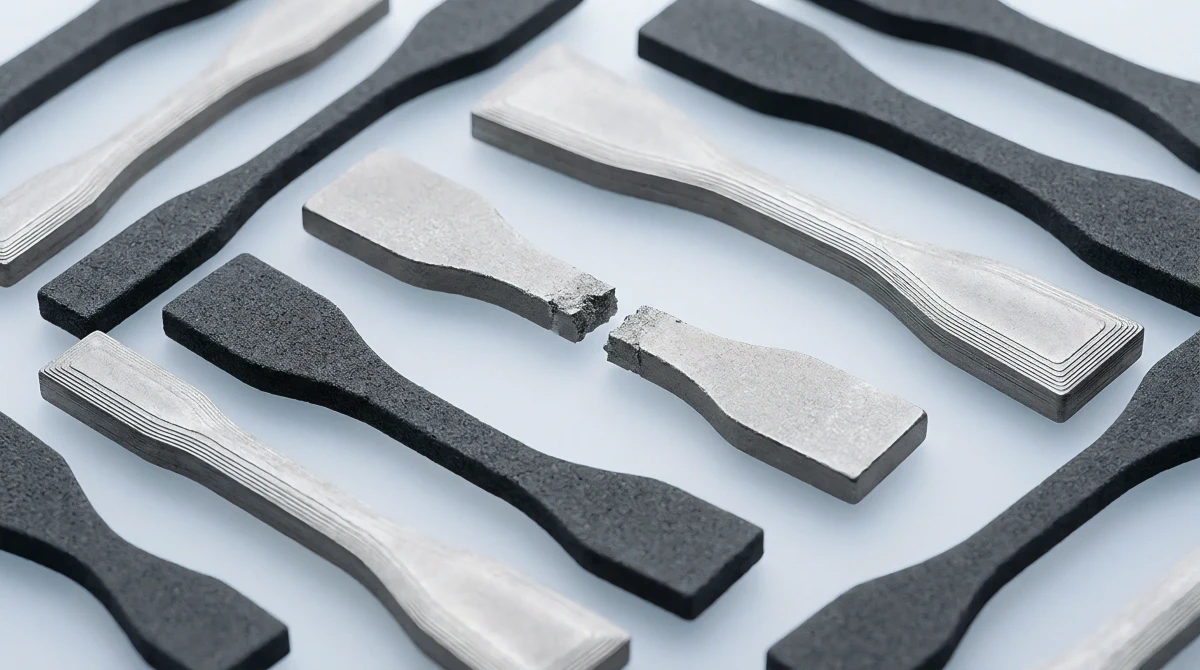
ISO 6892-1 is the tensile test method EOS uses for its printed metal specimens, giving yield strength, tensile strength and elongation. EOS reports its 316L results to it in the as-manufactured state, by build direction and with sample counts. The method table read for ISO/ASTM 52927 lists it for metal tensile properties. An order names it for witness specimens from the same build.EOS M 290 Values
On the 20 µm set, the vertical bar gives 480 MPa (69.6 ksi) yield, 560 MPa (81.2 ksi) tensile and 49 % elongation. The horizontal bar gives 540 MPa (78.3 ksi), 645 MPa (93.6 ksi) and 38 %. Those figures rest on 363 and 246 specimens. On the 40 µm set the yields are 490 and 530 MPa (71.1 and 76.9 ksi), from 162 and 72 specimens.Read More
Statistical Basis
EOS prints a tolerance interval beside each result. The 20 µm set uses T99, the 40 µm set T95 and the EOS M 400-4 set T90. On the 20 µm chart the strength lower bounds run from 413 to 605 MPa (59.9 to 87.7 ksi). EOS states that those intervals are not directly transferable to other systems.Direction and Condition
The test shows printed 316L weaker across the layers and more ductile across them, by 40 to 60 MPa (5.8 to 8.7 ksi) in yield. The results are as built. A part stress relieved at 900 °C (1,652 °F) or annealed at 1,150 °C (2,102 °F) is a different condition. The order says which condition the specimens are tested in.Specimen Request
An order names ISO 6892-1, the build direction of each specimen, the heat-treated condition and the number of specimens per build. It states whether the acceptance figure is a typical value or a lower bound.