Meaning
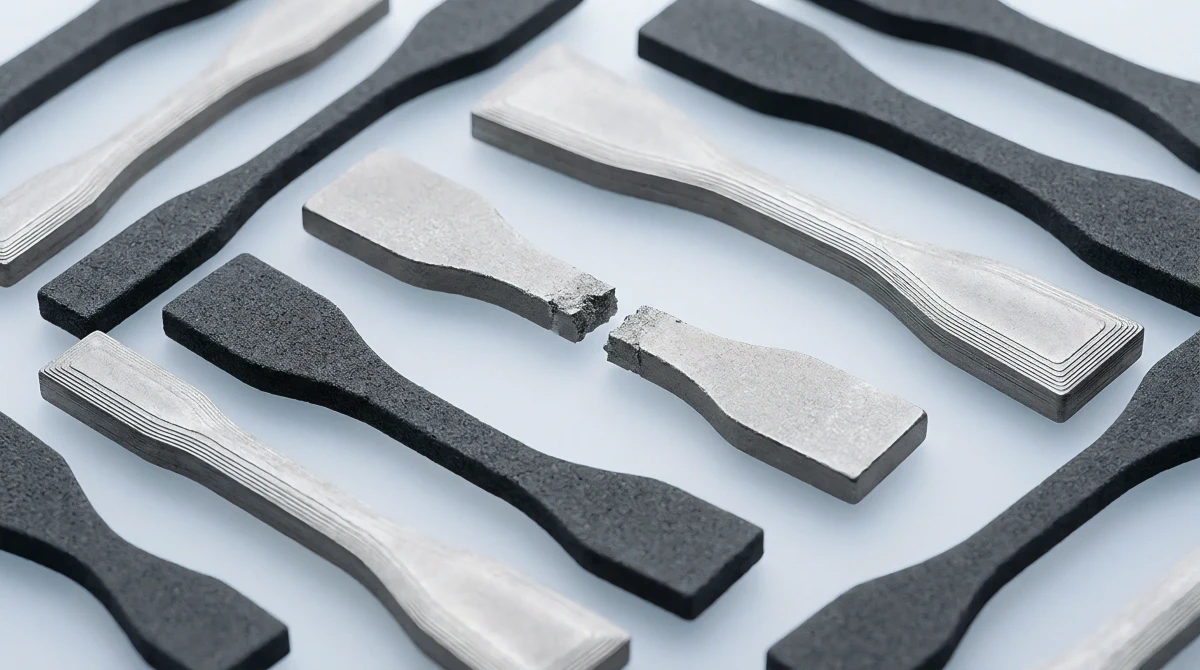
Yield strength is the stress at which a metal specimen begins to yield in a tensile test, reported by EOS as Rp0.2 under ISO 6892-1. It is the strength figure a structural calculation starts from. For printed 316L it depends on the build direction and the parameter set. EOS prints a typical value and a statistical lower bound beside it.EOS 316L Values
On the EOS M 290 at 20 µm, the vertical bar yields 480 MPa (69.6 ksi) and the horizontal bar 540 MPa (78.3 ksi). The 40 µm set on the material data sheet gives 490 and 530 MPa (71.1 and 76.9 ksi). The EOS process data sheet for 316L-4404 at 40 µm gives 490 and 560 MPa (71.1 and 81.2 ksi). The Core set gives typical figures of 450 and 500 MPa (65.3 and 72.5 ksi).Read More
Direction
The vertical yield sits 40 to 60 MPa (5.8 to 8.7 ksi) under the horizontal yield on every EOS set. On the 20 µm set the gap is 60 MPa, 11 % of the horizontal yield. A drawing for a loaded part says which way the load runs against the build direction.Design Figure
On the 20 µm set, the lowest typical yield is 480 MPa and the lowest printed lower bound 413 MPa (59.9 ksi). The bound is 67 MPa (9.7 ksi) or 14 % lower, and a structural calculation takes it. The intervals sit at T99, T95 and T90 on different sets, so the level travels with the figure.Heat and Yield
In stress relief, raising the temperature lowers the yield strength, so the residual stress relaxes by plastic yielding. Among polymers, Somos EvoLVe 128 reports its strength at yield, 56.8 MPa (8.2 ksi). An order names the method, the direction, the heat-treated condition and the statistical basis of any yield requirement.